

WhatsApp hogs the headlines, mostly. Brands put their budgets into conversational commerce, push notifications, and in-app messaging. But what if an OTP needs to reach a customer in a low-connectivity place in Bihar, or a flash sale alert needs to reach a million users within three minutes? It is the humble SMS that wins.
With over 1.18 billion mobile users in India by late 2025, and millions of users still relying on feature phones or facing inconsistent internet access or experiencing inconsistent internet connectivity, bulk SMS is not an add-on. It is often the only channel that gets through.
The question for Indian brands is not whether SMS still works. It is whether they are using it smartly enough.
What Is Bulk SMS for Business Communication?
Bulk SMS enables brands to send mass text messages to customers for promotional, transactional, or informational needs. Unlike emails or mobile app notifications, such SMS services send messages directly to users. Companies can use automated APIs and gateways for scalable, personalized, and real-time messaging.
Why Do Businesses Use SMS Services in India?
Despite the growing popularity of WhatsApp and similar messenger apps, the messaging platform continues to be a vital communication channel for Indian businesses. Its high open rates exceed those of email. Credible data shows that approximately 95% of text messages are opened and read by users within 3 minutes of reception.
Additionally, SMS API integration is cost-effective, scalable, and supports automation, making it crucial for business communication needs.
How Bulk SMS Works for Business Communication?
Bulk SMS for business communication in India operates through a streamlined workflow. The customer action triggers the business system, and it sends messages using an SMS gateway or API. The customers receive messages in real-time on their devices.
Modern platforms come with features like automation, personalization, and two-way communication. This helps Indian brands customize their communication and optimize campaigns to suit consumer needs.
Bulk SMS vs WhatsApp, Email, and Push Notifications
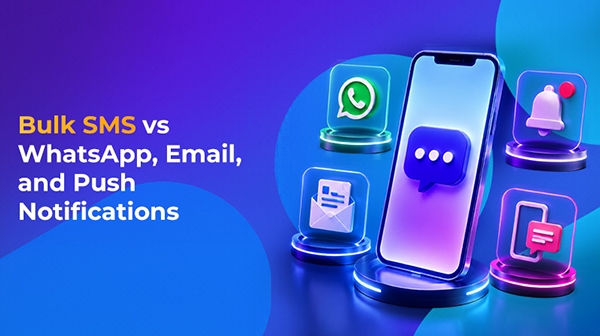
WhatsApp, email, push notifications, and SMS are channels designed to address specific business communication needs.
Email works well for details, but its lower open rates and spam filters reduce visibility.
WhatsApp is useful for two-way conversations and commerce. However, it requires internet access and an active WhatsApp account.
Push notifications require app installs and user permissions.
A business messaging solution is ideal for urgent, high-reach communication. Compatible with both smartphones and feature phones, it does not require an internet connection and is ideal for OTPs, payment alerts, delivery updates, reminders, and flash sale messages.
SMS, however, is not a replacement for WhatsApp or email. It is the dependable layer in a multi-channel communication strategy, especially when brands need fast, direct, and wide customer reach.
Automating Customer Communication with SMS Platforms
Bulk SMS helps brands engage in automated, real-time customer communication. This leads to improved user engagement and communication efficiency. Indian brands can set schedules for notifications, reminders, appointment alerts, and follow-ups with such solutions.
Integrated SMS APIs link business campaigns with CRM software, and this enhances automated processes. CM.com India takes this further with its conversational AI chatbots for prompt, two-way SMS interactions. This integration lets brands automate responses, qualify leads, and resolve queries faster, without manual efforts. They experience an overall improvement in customer experience.
Business Use Cases for SMS Platforms
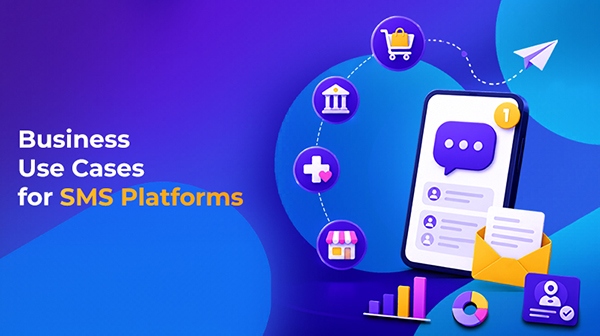
SMS platforms help improve major business workflows across different sectors in India.
E-commerce brands use SMS for order confirmations, delivery updates, and cart reminders.
BFSI companies utilize SMS for OTP authentication, transaction alerts, and security notifications.
Healthcare brands use SMS for appointment reminders and patient notifications.
Retail entities use it to send promotional offers, loyalty programs, and engagement alerts.
Choosing the Right SMS Platforms in India
Indian Brands need the right Bulk SMS service provider for bulk messaging. They should choose business messaging solutions with features like strong API integration, automation features, DLT support, analytics, and CRM sync. Such platforms must support scalable, personalized campaigns with real-time delivery tracking.
Indian brands must adhere to the latest telecom industry laws, including opt-in/opt-out norms, to win end-user trust.
CM.com India's SMS platform offers much more than regular bulk messaging. Its omnichannel setup lets brands connect SMS seamlessly with WhatsApp, email, and voice within a single UI. It ensures consistent customer communication across all touchpoints.
Bulk SMS vs Other Digital Communication Channels
Even with WhatsApp, email, and push notifications ruling the digital marketing realm, bulk SMS marketing retains its advantage for Indian brands. SMS gets delivered instantly, without internet, even in remote regions.
A section of Indian consumers still use feature phones, and business SMS services are useful to reach them quickly.
Conclusion
For Indian brands operating across geographies and customer segments, SMS platforms are not a legacy channel waiting to be replaced. It is the most consistently reliable way to reach customers — instantly, directly, and at scale.
The brands winning on customer communication are not choosing between SMS, WhatsApp, and email. They are using each channel where it performs best, with SMS as the backbone that ensures nothing falls through the cracks. CM.com India's Enterprise SMS solution gives you the automation, integration, and delivery reliability to make that happen — so every message counts, and every customer interaction moves the business forward.
FAQs
1. What is the difference between transactional and promotional Bulk SMS?
Transactional SMS is a message that gets triggered by a user action. These may include OTPs, order confirmations, payment alerts, or appointment reminders. These actions override DND status and are time-sensitive. Promotional SMS is a marketing message sent to customers, with the aim of increasing awareness or making offers. They are subject to DND regulations.
2. What is DLT registration, and why is it mandatory for SMS Platforms in India?
Distributed Ledger Technology is a TRAI-mandated registration framework that every business must comply with for sending commercial SMS in India. Businesses must register their sender ID, message templates, and entity details on a telecom operator's DLT platform. TRAI has deployed this to control spam messages. Without DLT registration, bulk SMS messages can’t be sent.
3. How do opt-in and opt-out rules work for SMS platforms in India?
TRAI regulations require Indian brands to only send promotional SMS to users who have explicitly given their consent. Every message must also include a clear opt-out option, typically a reply keyword or an unsubscribe link. Sending messages to users who have registered on the DND list is illegal.
4. How do businesses measure the ROI of their Bulk SMS campaigns?
Key metrics for measuring Bulk SMS ROI include delivery rate, open rate, CTR on links, conversion rate, and opt-out rate. Most robust SMS platforms offer built-in analytics dashboards to track these aspects. Comparing campaign costs against conversions and revenue generated gives them a clear idea of SMS marketing efficacy.
5. What is two-way SMS, and how can Indian brands gain from it?
Two-way SMS systems help Indian brands send and receive text messages for effective, hassle-free user conversations. They use it often for collecting user feedback, booking confirmations, survey responses, and resolving complaints. It adds interactivity to brand communication and helps improve customer engagement.