


The Marketers and customer experience teams in India are under immense pressure to offer faster, richer, and more measurable customer communication services. However, budgeting for messaging campaigns is crucial when they move beyond traditional SMS. As brands are increasingly using rich communication services, looking into the budget becomes vital.
RCS (Rich Communication Services) is the next generation of SMS, enabling rich media, verified business messaging, and interactive customer conversations.
Indian SMBs and enterprises running high-volume customer engagement across multiple channels need clarity on RCS business messaging cost. This is a must because cost predictability directly affects campaign decisions.
Google’s RCS Business Messaging frameworks show that pricing and delivery depend on carrier infrastructure and message capabilities. A fixed per-message model usually does not work well, and early RCS business messaging planning is a must for efficiency. CM.com India offers a powerful, affordable RCS business messaging solution with a strong focus on data security and personalization.
How Does RCS Pricing Work?
RCS messaging does not follow a single fixed pricing structure, and so brands struggle to estimate costs upfront. Unlike traditional SMS, where pricing is set per message, RCS pricing in India works differently. It is affected by a mix of messaging models, infrastructure layers, and message types. It varies according to the messaging platform and carrier policies.
Factors That Affect RCS Business Messaging Pricing
Indian brands eyeing RCS business messaging should know the factors affecting the pricing model:
Message volume - Higher volumes often reduce per-message cost through tiered or based pricing models.
Rich media usage – Using images, videos, carousels, or CTA buttons improves engagement but affects overall pricing.
Customer interaction level - More interaction can influence session-based billing models
Message type - Promotional, transactional, and service messages may get different pricing norms.
Geographic + carrier dependency - RCS pricing varies across regions and telecom service providers.
So, the cost of RCS business messaging depends on how rich, how frequent, and how interactive your messaging strategy is.
Prevalent RCS Pricing Models in India
RCS pricing in India typically follows flexible, usage-based models. The top RCS pricing models are:
Message-based pricing - Ideal for low-volume or transactional use cases, and pricing depends on rich media usage and delivery complexity.
Conversation-based pricing - Billing per engagement window, supports multiple message types per session.
Volume / campaign-based pricing – Pricing depends on total message volume, suited for large-scale RCS business messaging and campaigns.
Enterprise pricing - Custom contracts for high-volume messaging and customer engagement programs, often includes advanced features.
With CM.com's competitive pricing and user-friendly API, SMBs can move from message-based to conversation-based campaigns - without system-wide changes or hidden costs.
RCS vs. SMS Pricing - A Close Look
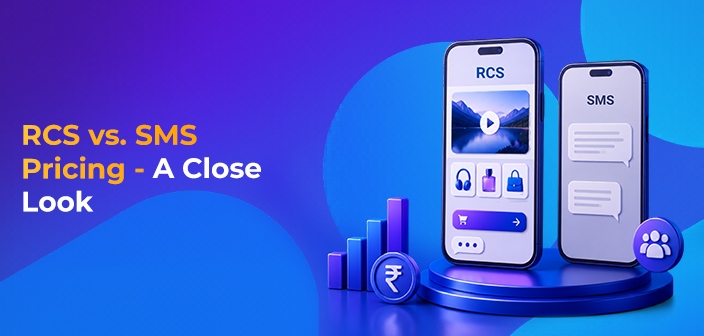
RCS business messaging pricing nuances become clearer when compared with regular SMS, on fee structure and communication value. SMS’s ease of use and wider reach fetch it points. But RCS’s richer media capabilities help brands analyze message cost vs engagement impact better.
Cost structure - SMS is typically priced per message while RCS follows variable pricing based on usage, message type, and engagement flow.
Message format & limits - SMS limits users to 160 characters per message while RCS supports rich media like images, videos, carousels, and branded templates.
Engagement capability – SMS misses out on visual interaction or tracking beyond delivery. However, RCS supports read receipts, typing indicators, and user interactions.
Effect on business - SMS is cost-effective but has content limitations, and RCS improves efficiency by increasing engagement.
Indian brands often choose RCS despite its higher per-unit cost over SMS. This is owing to its benefits like reduced follow-up messages, cart abandonment, and faster issue resolution.
How Businesses Should Budget for RCS Campaigns?
For budgeting for RCS messaging in India, brands must focus on usage patterns rather than fixed per-message costs. They should:
Define monthly business messages across campaigns.
Separate promotional, transactional, and engagement messages.
Analyze engagement outcomes by checking metrics like read receipts.
Start with small campaigns and then scale gradually according to performance.
Calculating ROI from RCS Messaging
Understanding ROI is important when evaluating RCS messaging in India, as pricing is variable and depends on usage, engagement, and message type. Brands must focus on performance outcomes over cost per message.
Key ROI indicators for rich communication chat services are:
Engagement metrics including open and interaction rates, and read receipts.
Rich media and interactive formats affecting click-through and response rates.
Despite higher per-message cost, richer interaction brings the desired outcome.
Conclusion
RCS pricing in India is shaped by usage patterns, message types, and the level of engagement. So, brands should look beyond per-message cost and analyze the overall value delivered through richer and more interactive communication.
While choosing an RCS business messaging API, Indian brands should also analyze aspects like security, flexibility, and customization, apart from pricing-related aspects.
CM.com India offers a customizable, secure solution that keeps RCS business messaging cost manageable, while packing in TLS Encryption support. It also complies with GDPR, DPDP, and broader data safety norms.
FAQs
1. How is RCS pricing calculated?
RCS pricing is calculated based on factors like message type, rich media usage, engagement, and volume. Unlike fixed SMS charges, it follows usage-based or conversation-based systems. CM.com India offers scalable RCS business messaging solutions that adapt to your campaign structure and scale.
2. What is the average RCS pricing per message?
There is no single average RCS price per message in India. The costs vary by message type, interactivity, and carrier. CM.com India provides affordable, transparent RCS business messaging solutions tailored to SMB and enterprise budgets, for cost predictability without compromising on rich media capabilities.
3. Why choose a platform like CM.com India over building RCS in-house?
Platforms like CM.com India handle carrier operations, fallback routing, compliance, and API stability smoothly. This removes the cost and complexity of managing different carrier integrations. You get a tested, scalable infrastructure and competitive per-message rates without the overhead.
4. Is RCS messaging supported across all telecom operators in India?
RCS availability in India depends on individual telecom operator infrastructure. Major carriers like Jio, Airtel, and Vi have been progressively rolling out RCS support, but the coverage is not uniform. Brands running high-volume campaigns in Tier 2 and Tier 3 cities should verify operator compatibility before using RCS as a primary channel.
5. Can RCS messaging be used alongside SMS as a fallback?
Yes, and this is actually recommended for Indian brands. When an end user's device or carrier does not support RCS, a well-designed RCS messaging platform automatically reverts to SMS mode. This hybrid setup protects campaign reach while keeping costs manageable. CM.com India's messaging setup supports this fallback system natively.