
 Back to blog

Ramadan Changes How Customers Engage, Not Why
Throughout Ramadan, customers in the GCC continue to browse, purchase, ask questions, and seek support. What changes is not intent, but the conditions under which engagement happens.
Engagement follows clear Ramadan rhythms. Activity often shifts to later in the day, particularly after Iftar, as customers return to their phones to browse, compare, and complete decisions. As Eid approaches, engagement becomes more time sensitive and concentrated into shorter windows.
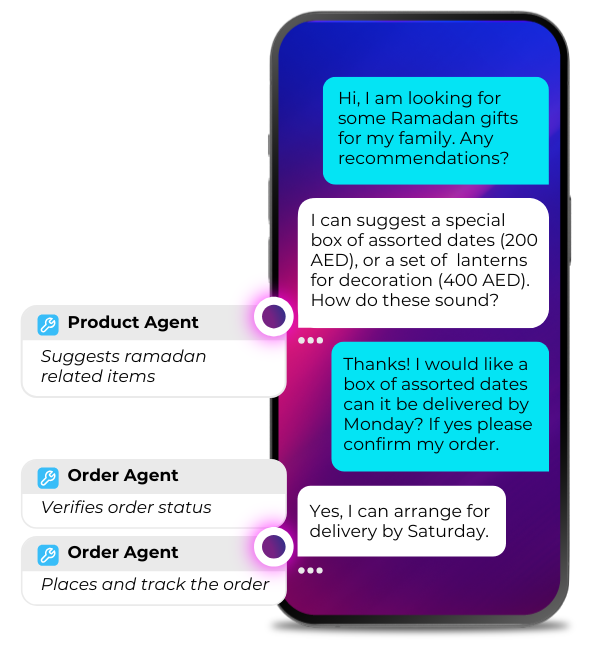
During these moments, reassurance plays a larger role in customer interactions. Purchases are often tied to hosting, gifting, and fixed moments of celebration, making timing and certainty critical. As a result, brands often see a higher share of inbound conversations focused on delivery confidence, product availability, and order confirmation.
Expectations are further amplified by communication preferences. 73% of adults who message online say messaging is their preferred way to communicate with businesses, and 75% expect to interact with brands in the same way they do with friends and family. During Ramadan, expectations around tone, clarity, and responsiveness increase, while tolerance for friction is lower.
The Real Challenge Is Coordination, Not Volume
Most customer experience issues during Ramadan are not caused by message volume alone. They are caused by fragmentation.
Marketing teams launch campaigns.
Service teams manage inbound questions.
Sales teams handle follow-ups and conversions.
When these efforts are not aligned, customers feel it immediately. Messaging becomes inconsistent, context is lost between touchpoints, and conversations restart instead of continuing.
This friction is felt more strongly because messaging is a personal channel. 72% of adults who message online say messaging feels more personal than other forms of communication. When conversations lose continuity or customers are forced to repeat themselves, frustration escalates faster during high expectation moments like Ramadan.
For many e-commerce brands in the region, Ramadan is not a messaging problem. It is a coordination problem.
From Messages To Connected Conversations
During periods like Ramadan, when engagement happens in shorter windows and expectations are higher, the way conversations flow matters as much as how quickly teams respond. Customers expect interactions to feel continuous, clear, and consistent, even when they move between channels or return later in the journey.
HALO supports this by acting as an intelligent AI layer across customer communication. On its own, HALO helps businesses manage conversations more smoothly by automating responses, guiding customers through common questions, and maintaining a consistent experience across channels such as WhatsApp, SMS, email, and chat. Using natural language understanding, it can interpret customer messages, deliver relevant answers, and personalize responses based on the context of the conversation. This allows teams to stay responsive around the clock, while reducing the effort required to handle routine interactions.
When HALO is paired with the Customer Data Platform, conversations become more connected over time. By bringing together customer preferences, interaction history, and product information, AI agents gain the context needed to guide customers more effectively, recommend relevant options, and handle repetitive requests with greater accuracy. This shared data foundation helps preserve continuity across channels and moments, which is particularly important during high expectation periods like Ramadan. The result is an experience where customers can pick up where they left off, and teams can manage engagement more efficiently without losing context as conversations progress.
A More Thoughtful Approach to Ramadan Engagement
A more thoughtful approach to Ramadan engagement is not about doing more. It is A more thoughtful approach to Ramadan engagement is not about doing more. It is about managing conversations differently when timing and expectations shift.
With HALO, brands can prepare in advance by creating AI agents that handle routine interactions, preserve context, and act across Service and Marketing touchpoints using shared customer data. This helps teams remain responsive during peak moments while keeping interactions consistent and aligned.
This approach supports how customers engage during Ramadan and helps establish stronger foundations for engagement beyond it.
Beyond Ramadan
Ramadan is a period that brings customer expectations into sharper focus. Brands that use this time to review how conversations are handled, carried forward, and supported are better positioned for the months ahead. Not because of individual campaigns, but because of the foundations they strengthen in everyday engagement.
As Ramadan begins, the question is not how campaigns will perform, but whether conversations are set up to continue smoothly. Are customers able to pick up where they left off? Are responses consistent across moments and channels? These considerations shape engagement readiness during Ramadan and well beyond it.







 +971 4 589 6035


