
 Back to blog

Consider: from the outside, you see the shop front. Maybe there's a sale on or special offers. Walking inside, you see men's or women's sections, a "new collection" sign, and some cool posters or flyers. A shop assistant greets you — even if it's just with a little nod or a smile at first. They'll soon wander over and kick off a conversation with you. They'll ask what you're looking for and offer expert, personalized advice. Once you've chosen, they'll walk back to the checkout with you, sort out any further questions you might have, wrap your purchase up nicely, take your payment, thank you for coming to the store, and wish you a very nice day!
This is the holy grail of retail — an easy, personalized, consistent, and pleasurable shopping experience. Of course, your customers would love you forever if you replicated this in your online store.
But thanks to today's tech-savvy, smartphone-toting, channel-hopping online shopper, you have an ever-growing stack of channels to wade through before you can start getting up-close and personal. Having a strong grip on your customer service channels is one of the key competitive differentiators between an online store that's "moving along nicely" and a store that is truly becoming a market leader.
When supporting customers in their online shopping pursuits, you should offer self-service and "assisted" services. "Self-service" channels refer to any media that your visitors can use to find out more information about your brand, product, or services. Think product pages, support pages, FAQ, knowledge base, community, and blog.
In contrast, main "assisted" service channels refer to channels in which your reps can provide support — social, e-mail, chat, and phone.
By offering both channels, you cater to the needs and preferences of different kinds of customers. Some customers are more autonomous, while some want immediate support from your customer service team.
We're going to look at the typical channel challenges you face, offer some pointers, and share a great framework to help you optimize those channels. To get started, let's take a look at these channels from a customer's point of view.
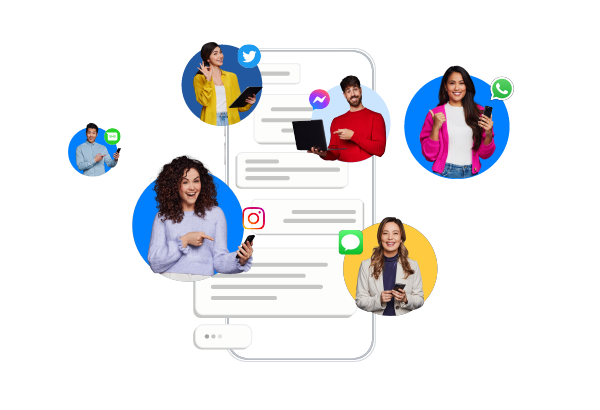
Channels from your customer's point of view
The omnichannel experience has always been significant in eCommerce. Your prospects and customers typically interact with your brand across several channels before and after purchasing something from you. As Sana notes: "Omnichannel eCommerce is an eCommerce sales approach that uses multiple channels and gives customers a unified experience across all channels, whether it's from in-store kiosks or other digital channels. This approach is essential because research shows that 73% of online shoppers use multiple channels while purchasing online."
Nailing this down further, different kinds of customers prefer other channels. For example, Forrester found that nearly one-third of customers have sent a mobile/SMS message to the company asking for help. In comparison, American Express found that 40% of customers would prefer to talk to a real person on the phone when it comes to more complex interactions, like payment disputes.
Channel preference also varies depending on the type of product, the urgency of the issue, and, most importantly, the kind of question.
But no matter what the issue, no matter who the customer is, they expect you to be "agile across all channels" — switching from one to another without any effort. There are three big things customers value more than anything else:
- A quick response — no matter the channel. Study after study shows that people most value getting a fast response from customer service teams. Many people expect an immediate response from the customer service team — with 90% saying they want customer service teams to respond straight to their problems or questions.
- A friendly response — no matter the channel. In this research from PWC, friendly service is rated as one of the most critical elements of a positive Customer Experience. However, different channels typically generate different degrees of satisfaction. For instance, as research has found, live chat offers some of the highest satisfaction rates, with a 73% customer satisfaction level.
- An effective response — no matter the channel. Customers are happy if the problem (or question) is solved in one contact whenever possible. When you understand what your customers want and how they want to do it, you can optimize each channel to the most appropriate resolution job.
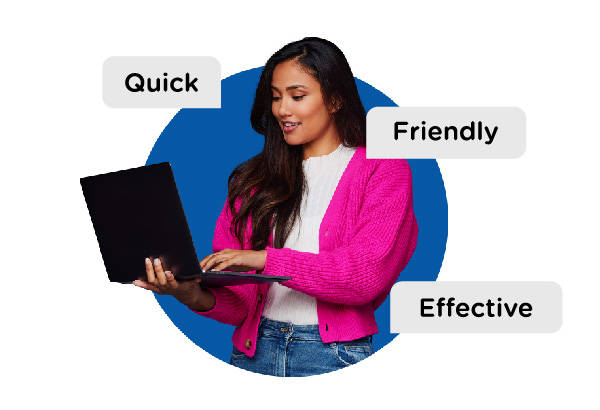
The pillars above are an excellent start for your channel strategy. Now, let's look at channels from your point of view.
Channels from your point of view
We've included a summary of the main channel challenges online store owners face — along with a couple of pointers too. Afterward, we offer a framework to start optimizing your channel strategy.
1. E-mail
Hopefully, you are already using a tool to manage support e-mail, such as Mobile Service Cloud. However, in our experience, many teams still use Outlook (Exchange) or Gmail. Using standard e-mail clients can become a severe problem when hitting a growth curve.
For example, when using Outlook Exchange, a customer support e-mail lands in multiple Outlook inboxes. When any one of the team members opens the e-mail, it shows up as opened in everyone's inbox. This can often lead to missed e-mails, duplicate responses, delayed responses, etc. Maybe even one of your team members drags a message over to a personal folder, at which point no one else can find it. It isn't easy to categorize e-mails. When you work in Outlook or Gmail, it's almost impossible to get any contextual data into the mix that will help you deliver outstanding service.
2. Phone
The main challenge with phone service is that when someone calls, your agents need to pull up an order and conversation history to see when that customer called last. Quite often, web stores cannot do this.
As such, it's challenging to analyze many issues people may be calling about correctly. And the last thing you want is for your customer to have to re-explain previous problems to yet another service rep.
At CM.com, we offer several voice solutions. You can provide an interactive experience and instant responses with conversational IVR and voicebot technology. You can route calls to the best agents and pass the call and customer details over to the rep to ensure a smooth transition and save your caller from having to repeat themselves.
Moreover, with the support of Conversational AI, you can make sure your company is on hand to solve customer problems, answer FAQs, and answer questions — even when a service rep isn't available.
3. Live chat
As we pointed out earlier, live chat is a clear growth opportunity. "Chatters" are a high-value segment. For example, Forrester found a 10% increase in the average order value when shoppers engaged with live chat before buying.
Although live chat often has the most significant satisfaction rating, it also brings particular challenges. The main one is that live chat is, well, live! It demands a response time in seconds, not minutes. And once you get more than one customer online, you need concurrent user capability in your chat app.
The success of live chat depends on how well your team is trained in the art of customer conversation. Integration with e-mail can also be a challenge. If you are to meet the customer's need for speed, you must draw on all available customer data from across platforms to solve their problem — instantly! If you manage it well, live chat can give an incredible boost to customer satisfaction and loyalty. But managing it can be challenging.
4. Social Media
Most eCommerce sites use social media channels like Instagram, Facebook, YouTube, and TikTok to share their content and drive engagement. While you can use social media to promote your products and share great content, look out for product or delivery questions and complaints. And then manage them appropriately.
When it comes to response times, what do your prospects expect? Well, no surprise here — customer expectations are high: 32% expect a response within 30 minutes. 42% expect a response within 60 minutes. On the other hand, only 2% use social media for customer service.
Speedy response times aside, each channel carries its own particular set of challenges. And it's often tough to know where to focus first. Good thing we're not done here just yet….
5. Messaging channels
Aside from your Instagram comment section or customer tweets, you'll also find customers and prospects coming to you with issues and questions across different messaging channels. Depending on their preferences, your customers and visitors will message you on WhatsApp, Facebook Messenger, via text, and more. Survey your customers to find out their favorite channels and make sure you're ready for the influx of messages on their go-to choices.
Many growing eCommerce brands find our Communications Platform a great way to keep track of customer messages and ensure quick response times. From WhatsApp to Instagram Messaging, use our API solution to use the conversational channels of your choice and manage them efficiently.
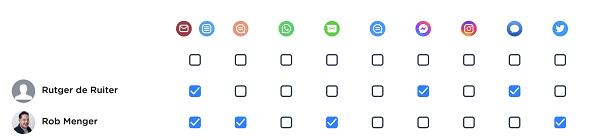
Other eCommerce companies use Mobile Service Cloud to manage a high number of customer messages. Use this solution to communicate with your customers across every popular messaging channel, integrate your favorite software and tools, and automate conversations with a chatbot when your team isn't available. Moreover, you can use Customer Profiles to personalize the customer journey better and drive revenue.
Two Steps to Optimizing Your Channel Strategy
At the start of this section, we noted that the holy grail is to replicate a brick-and-mortar store's easy, personalized, consistent, and pleasurable shopping experience. At this point, however, there's one more thing we need to add to the mix:
The cost of delivering that customer service experience you, and your customers, are after.
Considering both costs and customers' needs, you will be able to build a more profitable business. There are two steps to optimizing your channel strategy: The first step is to do your assessment of the actual business value of your channels (see our four questions below). The second step is optimizing your channel strategy to ensure you have the right people, processes, and tools in place. That way, you have a channel strategy you can scale!
Step 1: Four Questions to Assess Channel Profitability
How do you adequately assess channel profitability? Below, we've adapted Gartner's "Four Vs of Big Data" and applied it to customer service-assisted web store channels to help you in your assessment. Let's take a look at the four cornerstones:
- Volume: How many service contacts per month do you get in one individual channel? Why not use the split we suggested earlier: phone, e-mail, live chat, and social?
- Variety: What are the main types of issues you encounter in this channel? You could use complaints versus questions or, as we suggested earlier, split this by pre-purchase and post-sales. Both will work.
- Velocity: How quickly do customers get their issues resolved in that channel? This, considering our customer service principles, is one of the three primary needs of today's online shoppers.
- Value: What is the average order value of your customers in that channel minus the costs of servicing that channel? Look at the average order value per comment, question, or complaint, and then subtract the number of hours you put into that channel.
Once you've answered those four questions, you should have a more realistic view of how your channels are currently working for your customers and what it is costing you too. You can next use these insights to start shaping your service channel strategy. "People, process, technology," is a model many leading management consultants use to help businesses deliver on their business ambition.
Step 2: The Three Parts of a Great Channel Strategy
Below is an explanation of what each part entails with a series of thinking points. Your goal here isn't to tell your team what they are good, or not so good, at. Your goal is to ask them what they think. Nothing more.
- People: Ask your team what they believe are their strengths and weaknesses in each channel. Ask which one of them is best in which channel. Each channel is very different. And each team member has different preferences and skills. By mapping this, you will better understand the gaps in your channel strategy. Once done, you can get those who are best on one channel to train those not quite as good. This is a great way to get your team to coach each other — and already start to deliver better customer service along the way.
- Process: Once you have defined who is good at what, you should think about routing: What type of question should you route to whom based on their skills. For example, some of your team will be better at handling product questions and complaints. The process is the second level of shaping a channel strategy that works.
- Technology: Once you have defined who is good at what and who is best at handling which type of issues, it's time for you to think about how you can enable your team to deliver every time through the right channel tools. There are two main things to consider here: convergence and collaboration. By convergence, ask yourself if any of your team members can quickly and easily call up any information — from any channel — to solve customer questions. That means all the funky stuff we talked about earlier — conversation history, order history, and so on. Collaboration refers to how easily your team can collaborate internally — i.e., a quick, internal chat to solve your customer's problem.
Summing up, once you have people and processes in place, the technology decisions become much more manageable. You know who is best in which channel and what type of issues, and you will know what kind of technology you need to allow your team to deliver.
People, processes, and technology are the basis of a robust channel strategy. Understanding and addressing every element is critical for effectively supporting your customers. You don't need an elaborate plan; you can deliver great customer support on your customers' go-to channels with the right frameworks and tools behind you.
*This article was originally published in the ROBIN Guide to Customer Service for eCommerce.








 +971 4 589 6035


