

You send an appointment reminder. Your customer wants to reschedule. What happens next? They call your support team. They look up your phone number and send an email. Or they do nothing at all, miss the appointment, and you're left with an empty slot in your calendar. Meanwhile, the customer is frustrated, not because they didn't want to respond, but because responding required too much effort.

This isn't a lack of willingness. It's a lack of opportunity.
And it's costing your business more than you think: missed conversions, unnecessary support calls, and customers dropping off simply because interacting with you feels like too much work.
Conversational messaging channels like WhatsApp and RCS solve this problem - not by replacing SMS, but by turning one-way notifications into two-way conversations.
SMS is a monologue. Customers expect a dialogue.
SMS was built to deliver information, not to hold conversations. And for years, that was enough.
Today, those same customers chat with friends, family, and businesses on WhatsApp every day. They're used to instant two-way communication, tappable buttons, images, and rich interactive experiences. They expect the same convenience from the brands they interact with.
The numbers back this up: RCS messages generate up to 7x higher engagement than SMS. More opens. More clicks. More conversions. Not because the channel itself is magical, but because customers can finally respond.
What WhatsApp and RCS bring to the table
The difference goes far beyond two-way messaging. WhatsApp and RCS introduce an entirely new level of rich customer experiences.
Rich content
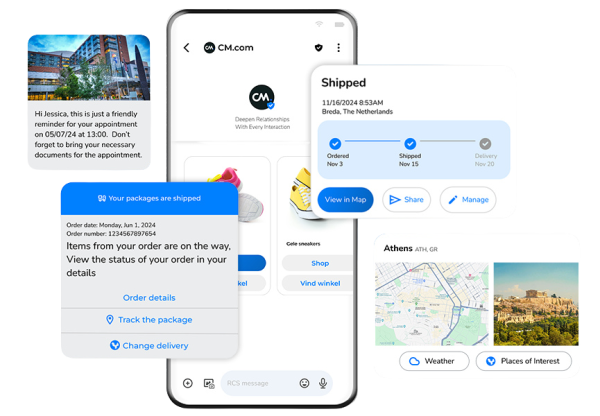
Move beyond plain text. Send messages with images, videos, product carousels, interactive buttons, and payment links. Show a product instead of describing it. Share a map instead of a street address.
Frictionless interactions
Let customers respond with a single tap using suggested reply buttons. No forms to fill in. No phone numbers to search for. No apps to download. The next step is built directly into the message.
Greater personalisation
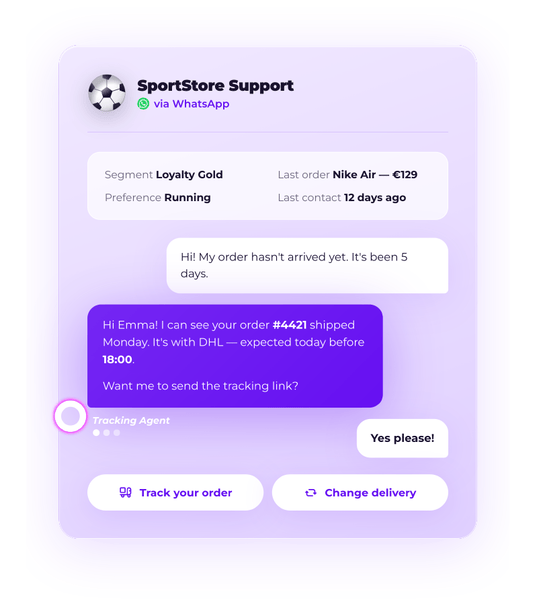
Combine customer data with dynamic content. Address customers by name, reference their order, and tailor offers based on their preferences and purchase history.
 Endless use cases
Customer support, managing and rescheduling appointments, delivery updates, guiding customers through issues or returns, but also marketing: targeted promotions with a product carousel and direct purchase button, abandoned cart follow-ups, loyalty offers with a payment link, or a new product launch featuring swipe-able images and a clear call to action. The conversation adapts to your objective.
WhatsApp or RCS - which should you choose?
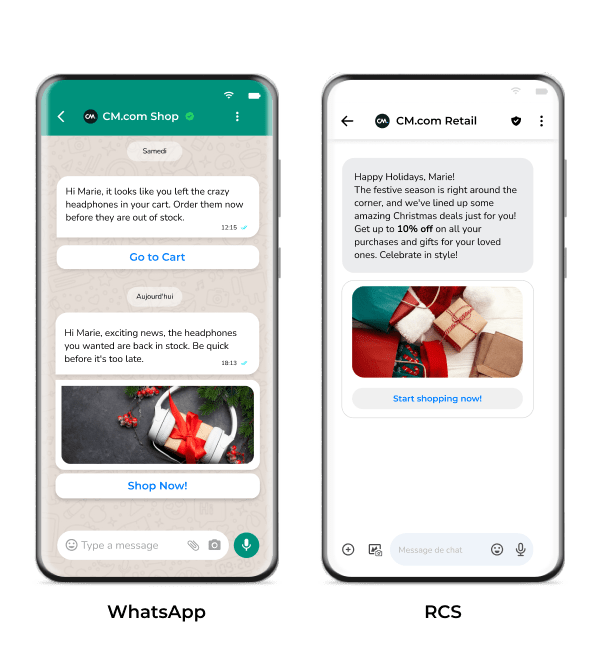
In short: WhatsApp offers the world's largest user base with over 2 billion active users. RCS is built into the default messaging app on Android & iOS devices, requiring no additional app installation.
The two channels overlap in capabilities while complementing each other. In practice, many organisations use both, depending on the messaging preferences of their customer base.
Read our detailed comparison to learn which channel best fits your business.
"But not all my customers use WhatsApp or RCS."
That's not a problem. Both WhatsApp and RCS support automatic SMS fallback. If a customer can't receive your message through the richer channel, they'll simply receive a regular SMS instead. Your reach never decreases - you simply add a richer communication layer where possible.
See how other businesses are already doing it
Retail: Lucardi
Lucardi, the Netherlands' largest jewellery retailer with more than 100 stores, experienced rapid growth in online sales. Along with that growth came a surge in repetitive customer questions about order status, returns, and complaints.
By adopting a conversational platform with Mobile Service Cloud, WhatsApp, and AI colleague Lucie, Lucardi now resolves 79% of all customer conversations fully automatically. Lucie answers customer questions 24/7, across every channel, in 72 languages, allowing human agents to focus on conversations that truly require personal attention.
Read the full Lucardi customer story →
Logistics: CheapCargo
CheapCargo is a digital freight forwarder connecting businesses with the best shipping providers. As operations expanded across the Netherlands, Belgium, and Germany, customer enquiries began growing faster than the support team could keep up.
Using Mobile Service Cloud and AI agent Chip, 64% of incoming customer questions are now handled automatically, including cancellations, shipment tracking, and bookings. The result: 27% fewer support emails and a support team free to focus on more complex logistics challenges.
WhatsApp is already planned as the next customer channel, allowing customers to communicate with Chip through their preferred messaging app.
Read the full CheapCargo customer story →
Healthcare: Amphia Ziekenhuis
Amphia Hospital in Breda had been using SMS appointment reminders for years, successfully reducing no-shows from 15% to 5%. However, SMS had reached its limits.
As the first hospital in Europe to adopt RCS, Amphia now sends verified messages so patients know they're genuinely from the hospital. Messages include direct links to the patient portal, QR codes for self-check-in, and richer healthcare information. Patients who don't yet support RCS automatically receive a regular SMS, making the transition completely risk-free.
"As a hospital, we want to innovate using proven technology that can be safely implemented for our patients. We are convinced that RCS is the messaging solution of the future." — Jobbe van Nuenen, Business Manager Healthcare ICT, Amphia
Read the full Amphia customer story →
From SMS to omnichannel: how does the transition work?
You don't replace your existing setup, you build on it. SMS remains your foundation and your fallback. You simply add the ability to have real conversations.
Through the CM.com platform, you can activate WhatsApp and RCS alongside your existing SMS infrastructure and manage everything from a single environment.
Mobile Service Cloud handles inbound customer support and conversations through one shared inbox across every messaging channel.
Mobile Marketing Cloud powers outbound campaigns, personalised messaging, and automated customer journeys across WhatsApp, RCS, and SMS.
HALO adds an AI layer that automatically handles routine enquiries, supports service agents, and helps scale customer experiences.
Finally, the Customer Context Platform connects customer data, conversations, channel history, behaviour, and preferences into a single customer profile. That means Mobile Service Cloud, Mobile Marketing Cloud, and HALO always work from the same context, regardless of which channel the customer uses.
It's not a major migration. It's an extension that fundamentally makes your customer communication richer, smarter, and more effective.
Ready to start the conversation?
SMS is a great place to start. But customers expect more than notifications, they expect conversations.
WhatsApp and RCS make those conversations possible. And with CM.com, you can make the transition without replacing your existing messaging infrastructure.



 +44 20 3868 7140


