
Deliver your emails worldwide in high-volume.
Our Email API is designed for high deliverability, scalability and seamless integration.
Full control over the email-sending process ensures your emails are correctly routed and delivered
Our email infrastructure is fully compliant (SPF, DKIM & DMARC) with the latest standards, and includes a dynamic suppression list.
Web hooks, IP-Whitelisting, dedicated IP and testing capabilities to provide the tools every developer needs
European data centers and relevant certifications (GDPR, ISO) that help protect data privacy and meet regional requirements
Use our Email Gateway to send transactional emails based on your own custom-built logic. Whether it's a purchase confirmation, password reset, or account update, our gateway will ensure delivery via a seamless integration with existing software. Send all types of transactional emails.
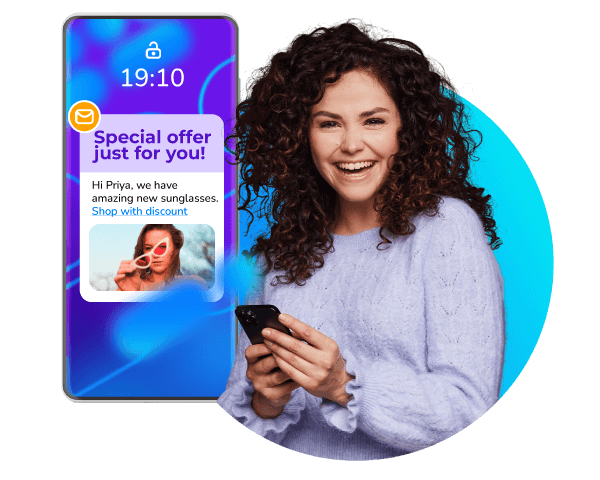
Send personalised promotional campaigns to target customer groups to showcase products, stimulate customer interests, and encourage your customers to purchase your products or services. Our Email Gateway will seamlessly integrate with existing marketing software.





Our Email Gateway API is developer-friendly, offering RESTful APIs, and detailed documentation to help make the integration easier.
Look at our documentationRequest access




Leave your information and get access to our Email Gateway API to try it out yourself! Start immediately and benefit from:
Global, high-volume mailing
Seamless and easy integration
Anti-block tools and guidance
Two Factor Authentication, or 2FA, is an effective way to protect your data and your customers. But how do you set up Two Factor Authentication? And what messaging channels can be used for 2FA?
What methods do you know for reaching and engaging your customers? Bulk SMS, WhatsApp, social channels, email marketing - the list is long and pretty exciting. Yes, today’s businesses have the world at their fingertips and can use communication methods that simply weren’t available back in the day.
If you're using SMS or email - or better yet, both - as marketing channels, you set up your message, send it out and analyse the results. But how do you improve that message for better results the next time you send out your SMS or email? The reality is that a large number of businesses don't use SMS or email marketing to their full potential, and that's because they don't always use the proper techniques to improve the open or conversion rates of their marketing messages. Once you know how to get started with the conversion optimisation of your marketing campaigns, you will be able to significantly increase your conversion rate and start to utilise your marketing channels to their full potential.
Every marketer dreams of everyone opening and reading their emails. However, we all know this is nearly impossible. The height of your email open rates is very dependent on your subject line. You make the first impression on your recipient with your subject line, which is critical to your open rates. You are probably already spending a lot of time on this, but did you know that you can achieve even better open rates with preview texts?
Big changes are coming to the world of email marketing. The iOS 15 update is arriving this autumn – as early as September. Apple has announced a number of new privacy protections that will have a massive impact on key metrics, tracking, list hygiene, and data collection.
When setting up email campaigns, it is tempting to rely on your intuition to predict what makes readers open your email and click-through. However, basing marketing decisions on assumptions might not always lead to the best results. Rather than relying on guesses, you’re better off by running an A/B-test. In this blog, we will explain what A/B-testing is and why you should run tests on your email campaigns by giving you 3 reasons to start right away.
The “80/20 Rule” as it is frequently called today, is an incredible tool for growing your business. If you can figure out which 20% of your time produces 80% of your business’ results, you can spend more time on those activities and less time on others. Likewise, by identifying the characteristics of the top 20% of your customers (who represent 80% of your sales), you can find more customers like them and dramatically grow your sales. However, many companies invest more in attracting new customers than retaining loyal customers. How is it that we no longer spoil loyal customers? Imagine what encouraging loyal customers can mean for your conversion! But how do you find out who your loyal customers are?
Select a region to show relevant information. This may change the language.














 +27 (21) 180 2560


