
A unified Customer Data Platform to create 360° profiles, deliver personalized experiences and boost growth.
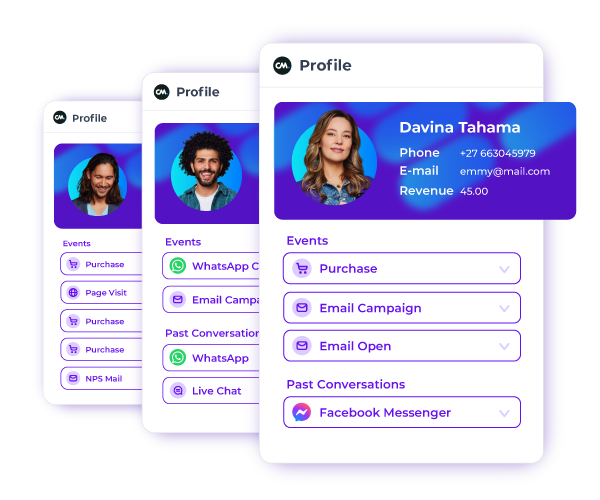
Increase relevance and revenue with personalisation at every touchpoint
Easily consolidate existing data platforms and remove redundant tools.
Empower employees to access and understand customer data all in one place.
Leverage your own data sources to build a rich understanding of each customer, decreasing dependence on 3rd party cookies. Our Customer Data Platform unifies data across all touch points into real-time 360-degree customer profiles, enabling you to nurture strong relationships and drive revenue.
Monitor visitors browsing patterns and merge with the relevant profile when possible.
Integrate first-party data no matter where it’s stored, eliminating dependence on cookies.
Accurately identify and merge data from the same individual into 360° customer profiles.
Enhance customer profiles with AI-driven recommendations, such as predicting behaviour, enabling customer service and marketing to provide truly personalised 1:1 interactions.
Connect existing data sources and allow the AI to learn from the start and continuously with every interaction.
Fuel the algorithms with your own business specific context and adjust when necessary to ensure accurate, relevant predictions
Gain transparency and view insights into why certain AI-driven recommendations have been suggested.








Easily identify and segment customer profiles based on historical interactions and real-time behaviour. With just a few clicks you can easily create data-driven audiences for every campaign.
Create, automate and activate campaigns based on customer behaviour and triggers to reach your customers at the right time, with the right information and on the right channel.
Our Customer Data Platform seamlessly integrates with our service and marketing tools to create a unified customer experience and unify data across departments. It effortlessly connects to our Mobile Marketing Cloud, AI Decisioning Engine, Mobile Service Cloud and more.
Our Engagement Platform connects our Customer Data Platform with marketing to ensure all data is directly available to deliver personalised campaigns and tailored content.
Our Engagement Platform integrates our Customer Data Platform with customer service, providing all marketing and service data right next to the conversation, all in one screen.
Our Engagement Platform connects customer data with our chatbots to ensure personalised conversations and vice versa, extracts data from chatbots to the Customer Data Platform.
A CDP or Customer Data Platform is software that collects customer touch points and interactions with your product or service from various channels and sources. It aggregates all this data from multiple sources to create a unified profile of each customer.
Learn moreCookieless data collection gathers user data and insights without using website cookies (data trackers that contain personal identifiers) either because the user rejects them or because they are not permitted. This method is growing given multiple tracking restrictions and privacy regulations.
Learn moreFirst-party data is customer data collected with consent and owned directly by your company (the data controller). It is a valuable source of customer insight in the age of data privacy, as regulations and security measures now make other types of data less secure, accurate, and reliable.
Learn moreClient and server-side tracking are two routes to collecting audience data. With client-side tracking, the user’s browser (client) sends data to the tracking platform’s server. Server-side tracking sends the user data to your website server first before being transferred to the tracking platform.
Learn moreAs a member of the customer service team, you stand on the front lines of customer interaction every day. In a world where customers demand quick and personalised service - long wait times, impersonal responses, or worse, incorrect answers, can quickly drive a customer away. Your goal, however, is to connect customers with your organisation and deliver the best answers and service possible. It’s incredibly satisfying to see a customer leave a conversation happier and eager to purchase your product. Your efforts can significantly enhance the customer experience, but you need the right tools to truly excel. Integrating these tools into a platform amplifies your capabilities and lets you experience the power of the platform effect.
Every business wants to communicate with its customers, whether for marketing, support, or operational purposes. But to do so, you'll need a way to get in touch with your customers- a communications platform. You can build software from scratch, integrate third-party software into your own systems, or implement new software all together. Are you still pondering the correct approach for your business? Then let's figure it below!
As a marketer you have undoubtedly heard of the term Customer Data Platform. But what is it and what are you missing if you don't have one? In this guide you can read everything you need to know to bring all your online and offline customer data together and create marketing campaigns that give customers that wow feeling.
It’s no secret anymore, consumers expect to be able to engage with brands on their mobile devices. For brands, it is the best channel to reach your customers and to drive sales. While not every business needs a mobile app to meet consumer demand, every business needs a smart mobile marketing strategy. We’ll take you through the mobile marketing errors that shouldn’t be made next year.
Customer personalisation is in hot demand these days — customers want it, and businesses want to deliver it. For your business to do personalisation right, start by unifying your customer data with a customer data platform.
Consumers are not yet used to handling insurance matters online and mobile, yet they prefer it. This means that insurers need to be accessible everywhere and at all times, but they are not yet responding to this sufficiently. KPMG's research among 70 executives of international insurers shows that they know this all too well. They expect to lose a large portion of their sales to InsurTech or FinTech companies. However, this is easy to avoid without shaking up the entire IT landscape. With CM.com's intelligent solutions, insurers can easily and quickly take steps towards digitalisation. In this blog, you can read which steps.
Today, a brand-new customer rules the marketplace. And from product to service to sales, they want their experience to be as personal as can possibly be.
It’s widely accepted that change is the only constant in the modern business environment (Forbes, 2017). If businesses don't build marketing strategies with built-in flexibility, they won’t be able to adapt to and respond to this change. You can have the best marketing strategy in the world, but if it doesn’t allow you to take advantage of an opportunity in almost real-time, or change your messaging based on fluctuating market conditions, it won’t be successful for long. Changes in consumer behaviour or new competitive offerings can make any good marketing strategy obsolete, but the ability to adapt allows businesses to respond to problems and seize new opportunities the moment they arise. Here is how modern communications platforms help businesses identify opportunities and respond with flexibility to give them a competitive advantage.
Data management platforms (DMPs), customer relationship management (CRM) systems and customer data platforms (CDPs) can all play an important part in the customer lifecycle, but telling the difference between them can get tricky. Let’s have a look at what they do, how they differ and what they can do for each business.
Select a region to show relevant information. This may change the language.




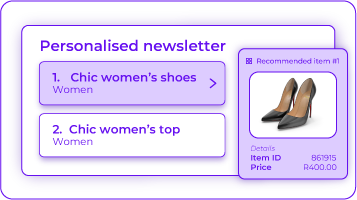
 Integrate customer data with marketing












 +27 (21) 180 2560


