

previous icon Back to blog
Oct 28, 2025
5 minutes read

The Business Impact of Agentic AI: now and in the future

Imagine customer inquiries being answered 24/7 without wait times, automatic updates on delayed orders, or fully digital shopping assistants guiding customers from browsing to purchase. These are just a few examples of what Agentic AI can achieve. In this article, CM.com’s Marketing Lead AI & SaaS, Sander Harryvan, and Product Marketer, Tom Faas, share their insights on where businesses currently stand in adopting Agentic AI, what the next phase looks like, and why Agentic AI will have a profound impact on the way we do business in the coming years.

Kiki Beekers
Kiki Beekers,
Growth Marketeer

What is Agentic AI?

Agentic AI is a form of artificial intelligence that can act autonomously within a defined scope. AI agents make independent decisions, perform tasks, and learn from their experiences. The term "Agentic" refers to agent-like behavior: virtual employees that take initiative on behalf of an organization.

In practice, this means AI agents can handle a wide range of tasks, from generating reports and answering customer inquiries to updating CRM systems with new order data.

Also read: Generative, Agentic and Predictive AI explained.

From Experimentation...

According to Sander, as of 2025, we are still in the experimental phase of Agentic AI. “Businesses are actively exploring what’s possible,” he explains. “The focus is currently on testing isolated use cases: one department, one process, or a small team experimenting with an AI agent.”

This phase is reminiscent of how organizations initially embraced personalization. “When personalization tools first emerged, marketers started with small adjustments, like product recommendations in emails. Over time, personalization became an integral part of the entire customer journey. The same will happen with Agentic AI: from experiments to structural deployment and, eventually, full integration.”

Companies using AI agents to answer customer inquiries or automate repetitive tasks are already saving time, working more flexibly, and delivering higher-quality service. However, this is still a phase of discovery and learning. “Organizations rolling out their first use cases are already seeing promising results,” says Sander. “But scaling up and entrusting AI with more responsibility still comes with some hesitation. That, too, is just a matter of time,” he continues. “As trust in the technology grows through successful cases, businesses will quickly scale up their use of Agentic AI.”

Toward Structural Adoption...

At the same time, we’re seeing a shift in consumer behavior. Customers increasingly expect seamless, natural communication with businesses—whether through chat, voice, or other interactive interfaces. Structural adoption of Agentic AI is therefore not only essential for optimizing processes or staying competitive but also for meeting these evolving customer expectations.

Once AI agents are deployed on a structural level and interaction through AI becomes a natural part of customer communication, the focus will shift from experimentation to efficiency, scalability, and growth. Businesses taking this step will build on their initial successes and eventually deploy AI agents across multiple departments.

“You can already see companies automating multiple processes simultaneously,” says Tom. “AI agents will soon collaborate with each other, provide consistent support to employees, and improve teamwork across departments. While they currently handle simpler tasks, their roles will become increasingly strategic, expanding to multiple departments or even organization-wide.”

The structural adoption of Agentic AI will have a significant impact on daily business operations, enabling:

  • Faster decision-making through real-time data processing.

  • Lower operational costs thanks to automated workflows.

  • Enhanced customer experiences through instant, personalized interactions.

  • Higher productivity as employees focus on strategic work.

Toward Full Integration

Over the next five years, we’ll move toward the full integration of Agentic AI. Businesses will be partially run by AI, with humans overseeing, correcting, and optimizing processes. Sander explains: “In the future, we won’t even think about using AI—it will simply be part of our daily work.”

The business impact of full adoption will be profound, influencing every aspect of operations:

  • Operationally, AI agents will optimize processes in real time.

  • Strategically, AI agents will make faster, data-driven decisions.

  • Culturally, roles and required skills for employees will evolve.

Customer interactions will also continue to transform. While we’re currently taking the first steps toward conversational interfaces (systems that allow customers to communicate with businesses in natural language), this will evolve into fully-fledged conversational commerce. Instead of searching through websites or filters, customers will engage in conversations with AI and make purchases within the same digital interaction—just as they would with a store employee, but fully digital, personalized, and automated.

Sander adds: “Businesses will increasingly structure their customer interactions as ongoing conversations, with AI responding in real time to the context and individual needs of consumers.”

HALO: The Foundation for the Next Phase of Agentic AI

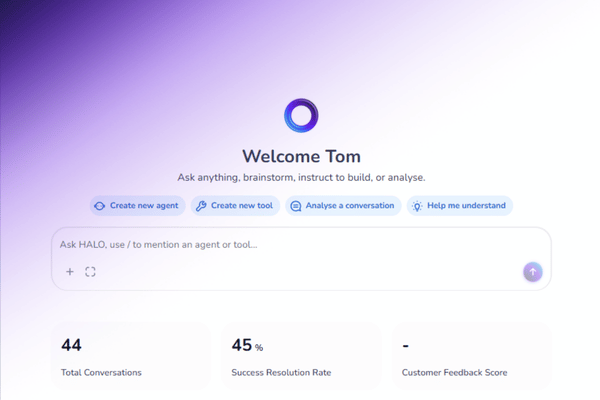
HALO, CM.com’s AI platform, serves as the connecting link across all phases of Agentic AI—from experimentation to full integration. While companies like OpenAI and Gemini focus on developing AI models, HALO provides the infrastructure for businesses to build their first AI agents and gradually scale them into comprehensive AI solutions.

Sander explains: “We don’t build models; we build a platform that works with multiple models. This allows customers to choose the AI that best fits their use cases. Some models excel at coding, others at generating text or analyzing data. We help them select the right combination.”

HALO stands out for its:

  • Security and compliance: HALO meets European standards for data and governance.

  • Flexibility: The platform supports both customer-facing applications and internal process automation.

  • Scalability: Organizations can start with a single agent and easily expand to broader applications of Agentic AI.

Tom concludes: “Agentic AI is no longer a distant future. It’s the logical next step for organizations looking to work smarter, more humanly, and more efficiently. And those who start now will build a sustainable competitive advantage.


Was this article interesting?
Share it!
Kiki Beekers
Kiki Beekers,
Growth Marketeer
logo linkedin icon

Latest Articles

3 types of AI
Oct 15, 2025 • AI

Unleashing the Power of AI: How Generative, Agentic, and Predictive AI Are Transforming Customer Experience

Artificial Intelligence (AI) has been in development for decades, but the way we use it today has changed dramatically. With the advent of ChatGPT and other applications, AI has suddenly become tangible for the general public. While it was previously used primarily for specific, often invisible applications (think fraud detection in banking or predictive maintenance in industry), it now actively assists in content creation, enhancing customer experiences, and streamlining processes. Within customer experience, three forms of AI are particularly relevant: generative, agentic, and predictive AI. In this article, we’ll break them down and explain how to leverage them effectively.

halo-insurance
Oct 10, 2025 • AI

From Claims to Customer Questions: How AI Agents Help Insurers

The insurance industry is known for its complex processes and heavy administrative load. Fragmented communication, outdated systems, and complicated policy conditions mean that finding the right information or processing changes often takes far longer than it should. AI agents can change that. They answer questions, pull real-time data from internal systems, and seamlessly trigger processes.

blog-halo-real-estate
Oct 02, 2025 • AI

AI Agents in Real Estate: Streamline Inquiries and Deliver a Better Buyer Experience

In today’s competitive global real estate market, agencies are flooded with inquiries on listed properties. Buyers expect instant answers about availability, pricing, and next steps — often outside office hours. For real estate agents, this creates a heavy workload: handling repetitive questions, scheduling viewings, and informing disappointed buyers when a property is already sold or oversubscribed. Without automation and smart workflows, agencies risk being overwhelmed, leading to frustrated buyers and missed opportunities for meaningful interactions. HALO, CM.com’s AI-powered engagement platform, helps real estate companies streamline these processes. AI agents work 24/7, provide human-like responses, and handle routine tasks instantly. This frees agents to focus on what matters most: building relationships and guiding serious buyers through the transaction.

blog-ai-agents-live
Sep 23, 2025 • AI

How AI Agents Are About to Transform the Music and Events Industry

The live events industry - from sports matches to festivals and concerts - is under pressure. Fans demand more, technology evolves constantly, and internal teams are stretched thin. In this shifting landscape, AI agents aren't here to replace people, but to amplify them - bringing structure, speed, and clarity where it's needed most.

Implementation checklist for AI agents
Sep 23, 2025 • AI

Your AI Agent Implementation Checklist

AI agents aren’t just shaping the future they’re transforming how companies serve and connect with their customers right now. From answering service requests instantly, to guiding shoppers through a purchase, to spotting upsell opportunities in real time, the question is no longer if you should implement AI, but how quickly you can put it to work.

blog-picking-ai-platform
Sep 09, 2025 • HALO

From Selection to Success: How to Choose the Right AI Platform

An AI platform isn’t just another tool you purchase. It’s the foundation on which your organization operates and innovates. The choices you make today will shape how you work in the future. While you may start with just a few agents supporting specific use cases, over time more processes will be taken over by agents. That’s why it’s critical to ensure the foundation you lay now is cohesive, scalable, and backed by solid governance and compliance.

blog-halo-ecommerce
Sep 09, 2025 • AI

AI Agents: The Accelerators of Conversational Commerce

The way consumers search for and process information online is rapidly changing thanks to AI. Where we used to type in search terms, scroll through dozens of results, and manually filter them, we are now getting used to having conversations. With ChatGPT, Google’s AI features, and other assistants, answers come faster and are more relevant. That same way of interacting is now taking over e-commerce at high speed. For retailers, this is the moment to step in: the webshop as we know it—where customers have to actively search themselves—is giving way to personal conversations that directly lead to action.

blog-ai-platform-comparison
Sep 09, 2025 • AI

Choosing the Best AI Platform: Comparing Features, Costs, and Use Cases

AI platforms are playing an increasingly important role in how companies organize their customer service and marketing. Whether you run a small support team handling large volumes of inquiries or manage an international organization processing thousands of interactions a day, choosing the right platform makes a big difference. But what AI platforms are out there? How do they work, and in which situations do they really shine? In this article, we compare six widely used AI platforms: HALO, N8N, Neople, Intercom, Zendesk, and Salesforce. We’ll explore their strengths and weaknesses and show which type of organization benefits most from each.

Is this region a better fit for you?
Go
close icon