
The reason is twofold. First, the technology itself has become more integrated with how people prefer to communicate. We’re talking integrations, a merging of channels and chat. Second, is the explosion in AI, Artificial Intelligence. Deep learning and Natural Language models have given chatbots a much broader range of use cases, making them useful in more circumstances. And the results seen from generative AI are positive.
What this means is that customer service chatbots are no longer a checkbox nice to have – they’re a secret weapon for improving customer service across the board. They’re based in the cloud to reduce your IT hassles. Connected to databases to give faster and more meaningful responses. And – most importantly – they integrate seamlessly with multiple channels to ensure your customers never feel they have to adjust to someone else’s way of working.
This is why chatbots are having a moment. But not all chatbots are created equal. So, let’s see what CM.com’s chatbots bring to the party – and why you can count on them to deliver consistent, high-quality customer service that sends your CSAT scores skyward.
One Chatbot to Rule Them All. Integrating AI Across Channels.
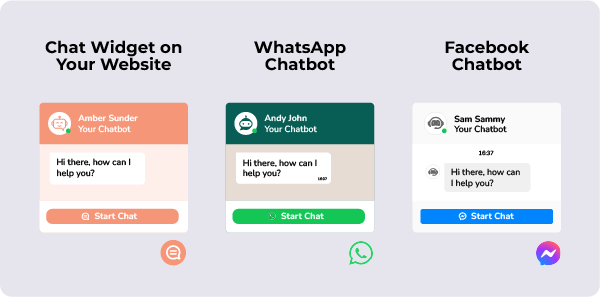
Let’s start with the big one. Customers don’t want to switch between a web chatbot, an automated email, and a messaging service – they want answers on a single channel, preferably in a single interaction. So, your AI must converse on whatever channel they use – time-shifted email, a text typing window, or messaging apps like WhatsApp – but use the same knowledge and learned behaviour (“smarts”) across all.

This is the definition of an omnichannel chatbot. The algorithm (and the data it uses) are separate from any communications channel and can be integrated with all channels, from web widgets to phone apps. Many channels, but one chatbot. This makes it easier to offer consistent service and to upgrade and extend your chatbot when new models and data become available.
Needless to say, this is how CM.com works. At its core is intent classification: working out what a user’s trying to achieve and generating responses likely to answer that goal. But that processing isn’t dependent on the channel your customers are using; a question can be asked on any medium, and the response given on the same one.
AI on AI: Using Generative Methods to Produce Training Data
Building an AI is one thing; training it – which usually means grinding out reams of test data and sample content – is another. The latter tends to be the most time-consuming part of the process; some researchers spend years training their models. Which isn’t much use if you’ve got a customer on hold.
Hence another feature to look for in an omnichannel chatbot: ease of training. At CM.com, we’ve gone recursive on this, using AI to train our AI – an AI generates realistic and probable customer queries and other text, and the chatbot is trained on that output, which can be wider and more varied than “plain” customer data. It also means you don’t have to spend endless hours guessing how different customers will ask the same question.
It means your chatbot can answer a greater variety of queries in a more diverse range of circumstances and be rolled out in a much shorter period. And during the process, you can test it and adjust for accuracy as often as you like, continually climbing the decimal points toward customer service perfection.
So Many Channels, so Many Choices…
Of course, with so many channels capable of being integrated, the next question is which ones to focus on. The simple answer: the ones your customers use. So, the first task is to see where your customers interact most and integrate those channels first. Look at:
On your own website. Social media may get all the traffic, but customers will still come to your own site for answers – especially with the market growing sixfold from 2016-2024. Your own branded site is also a great environment to deploy your chatbot first.
On Facebook Messenger. Customers viewing your branded Facebook for Business page, or clicking through from an ad, often want to contact you on the same medium – and fortunately, CM.com’s conversational AI chatbot integrates fully with Facebook Messenger. With nearly 3bn monthly active users (almost half the human population) you can’t afford not to be there.
On WhatsApp. Nothing beats the comfortable, familiar environment of your own phone apps for carrying on a conversation. An incredible 1 in 4 people use it to stay in touch with friends and family. And WhatsApp for Business now lets you join them – subject to strict rules and codes of practice. The great thing about CM.com’s WhatsApp integration? Those rules are largely baked into the integration itself, keeping you on the right side of the law wherever you operate.
On Instagram. Believe it or not, the Influencer-driven app (the world's 8th most visited web property) is about more than beach poses and pictures of food – users reach out to brands on their Instagram accounts and expect answers. Particularly if you’re in the consumer space, think seriously about integrating Instagram into your omnichannel chatbot.
…and Know When to “Integrate” a Human CSA
Reading the above, you might think we’re so all-in on chatbots we see no role for a human Customer Service Agent. That’s wrong. Many customers want to experience the emotionality and human connection of personal interaction, especially when they need a difficult problem resolved that needs someone to take action. So humans are an essential “integration” of your service desk and always will be.
Fortunately, CM.com makes it easy. At “trigger events” such as a customer asking to speak to a real person, the omnichannel chatbot automatically hands over to a human – on the same channel. A seamless switch, no annoying breaks. Ensuring that when major decisions need to be made, a person with authority can make them.
From Web-Widget Chatbot to Omnichannel Conversational AI
That’s the dream – well-trained and accurate AI that converses in natural language, seamlessly integrated with the channels your customers use, and ready to switch between them without losing context or content. That dream is here today, with CM.com’s Conversational AI Cloud. And we’d like to talk to you about it. Why not open the conversation today?