

This process, known as an opt-in, is designed to ensure that users have control over the messages they receive on WhatsApp and to prevent businesses from sending unsolicited messages or spam. Users must always have the ability to opt-out or unsubscribe from receiving messages from a business at any time, should they no longer wish to receive communications.
What Is the WhatsApp Opt-in Policy?
Before we get into the details, it’s worth noting that WhatsApp's policies and guidelines can and almost certainly will evolve over time; so it's always a good idea to refer to the official WhatsApp Business documentation or contact WhatsApp directly for the latest information regarding opt-in requirements.
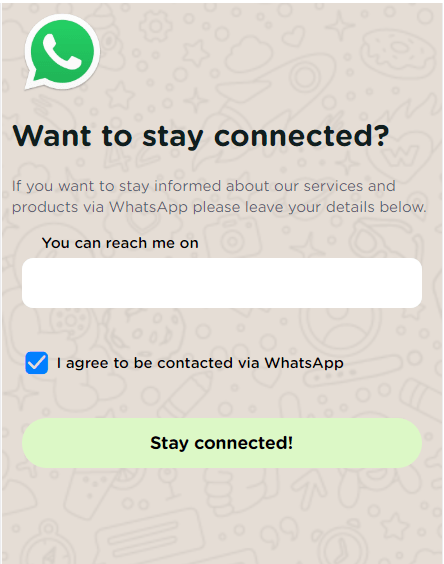
An opt-in is basically a permission request that a business sends to a consumer to be able to send them (promotional) messages via WhatsApp (or other channels). As we'll see shortly, there are several third-party channels through which businesses can obtain customers’ consent. However, it's important to note that before doing so, the following requirements must be met:
The business has to state clearly that a person choosing to opt-in will receive messages from them
The name of the business that a person is opting in to receive messages from must be clearly stated
Businesses must be prepared to comply with applicable law in all cases when required to do so
Update (November 2024): Meta updated the WhatsApp Business Messaging Policy so that an opt-in no longer needs to state that messages will specifically be delivered via WhatsApp. A general opt-in to receive marketing or service messages from your business, collected on any channel, now satisfies Meta's platform requirement, provided it still meets the requirements above and complies with local law. In other words, if you already have a valid marketing opt-in from a customer that doesn't mention WhatsApp by name, Meta's policy no longer treats that as a blocker.
This is a platform rule, though, it doesn't override data protection law. See the GDPR note below before relying on a fully generic opt-in.
Simply put, you must get a clear opt-in, but where you get this opt-in is essentially up to you provided that the above points are sufficiently observed. If you already have an opt-in from a customer on another (messaging) channel, then this consent is also valid for WhatsApp. No need to ask for an additional opt-in.
Which Channels Can I Use to Get Opt-ins?
This is where businesses can start to get creative. Below is a list of just some of the many channels that you can make use of to obtain active opt-ins from your customers:
The company's website, where the customer is directed through a pop-up ad or through direct access
An opt-in email or SMS, where companies ask current subscribers through an opt-in message if they would like to receive messages via WhatsApp
A mobile landing page alongside your SMS campaigns, where customers give their consent by providing their phone number on the landing page and clicking a checkbox
QR codes on packaging, posters, or physical product catalogs that put customers through to a chat
A WhatsApp thread, where companies can ask customers to opt in during an active conversation
In-person, where the customer opts in by signing a document in the company's physical store or during delivery, etc.
Via the use of social media ads where users can swipe up or click on a story and be sent to WhatsApp directly
Also read: How To Grow an Audience on WhatsApp >
Are there any requirements for gaining consent through third party requirements?
To make designing your company’s opt-in process a bit clearer, below are the Third-Party Requirements as stated by WhatsApp itself.
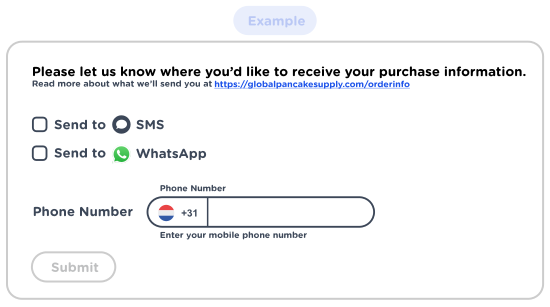
The opt-in must have a visual element (check box or similar) next to the WhatsApp name + logo.
Where a phone number is collected as part of the opt-in, the user should be able to enter or edit it themselves, meaning he has control over what number is used.
Also, it must be explained clearly what information will be received and that this will be shared via WhatsApp.
Note: Since November 2024, Meta no longer requires the opt-in flow to reference WhatsApp or the WhatsApp logo by name, a channel-agnostic opt-in can be valid at the platform level. We still recommend being explicit about WhatsApp as a channel wherever GDPR or similar data protection law applies (see below), and as a best practice generally, since it reduces block/spam-report rates.
A customer sending a message to a company does not, in and of itself, provide the latter with an opt-in. If a customer sends you a message, you may send them replies for the duration of the 24-hour customer care window. However, in order to send business-initiated messages to customers outside of the window, a prior opt-in is required.
Meta's Opt-in Rule vs. GDPR - What's the difference?
Meta's WhatsApp Business Messaging Policy and GDPR are two separate rule sets, and satisfying one doesn't automatically satisfy the other.
Since November 2024, Meta's platform policy accepts a general marketing opt-in that doesn't name WhatsApp specifically. GDPR, however, requires consent to be specific and informed, meaning your privacy notice needs to clearly disclose which channels you use to communicate (including WhatsApp) and how that data is processed, ideally naming Meta/WhatsApp as a data recipient given messages route through their infrastructure.
In practice: if your privacy notice or consent flow doesn't mention WhatsApp at all, a generic opt-in may satisfy Meta's platform rule but is unlikely to hold up as valid GDPR consent for EU contacts. Before messaging EU customers on WhatsApp using a pre-existing generic opt-in, check that your privacy notice explicitly names WhatsApp as a channel and discloses the related data processing.
What Usernames Mean for Your Opt-in Flows
As of June 2026 WhatsApp is rolling out WhatsApp usernames, allowing users to adopt a username and choose to hide their phone number from businesses. If a customer opts in through a channel that collects a phone number directly, such as an SMS or landing page opt-in, nothing about your process changes. But if a customer starts a conversation through a username, for example by clicking a WhatsApp entry point or replying to a Click-to-WhatsApp ad, you may only receive their Business-Scoped User ID (BSUID) rather than a phone number.
That doesn't affect the validity of the opt-in itself, but it does affect what you can do with it afterwards. If your opt-in record, CRM, or campaign logic assumes a phone number will always be attached, plan for cases where it isn't. Where you do need the phone number, for example to keep messaging that customer on other channels, use WhatsApp's native contact-sharing flow to ask for it explicitly rather than assuming it will arrive automatically.
For a full breakdown of what's changing and what your business needs to prepare, read our guide: WhatsApp Usernames: What Your Business Needs to Know
Best Practices for Obtaining WhatsApp Opt-ins
As mentioned previously, WhatsApp already has a number of features in place which serve to ensure compliance with privacy regulations and generally build a more positive relationship between customers and online businesses. However, it’s always important to think about the customer experience that you are offering users and the best practices that should be observed at all times. Here are some of the points that you ought to have in mind when it comes to obtaining opt-ins for WhatsApp Business:
Keep things relevant
Businesses should clearly communicate the value and benefits users can expect when they opt in to receive messages from your business. You can offer them exclusive content, promotions, access to customer support, reservation updates, policy updates, appointment reminders, and anything else that you believe will be relevant to them.
Avoid spamming customers
WhatsApp Messaging Limits already define the maximum number of unprompted messages that can be initiated by a particular phone number in a period of 24-hours. However, if customers feel that your messages are repetitive or annoying, they can still report you for spam or choose to opt out from receiving messages.
Keep on top of your quality rating
The quality rating of your message templates is calculated through usage, customer feedback, and user signals. WhatsApp can temporarily block message templates that have been given a poor rating by customers, which can ultimately have a negative impact on your marketing operations. To stop this from happening, make sure your message templates are of the highest possible quality and relevance to your customers.
Transparency is key
Clearly communicate to users how their data will be used and protected. You should explain the types of messages that will be sent, how often they can expect to receive them, and reassure customers that their data will be handled safely and responsibly. Businesses should also include clear instructions on how users can control their preferences or can opt out of receiving messages at any given time. This kind of transparency allows for increased trust and confidence in your business on the part of the customer.
What About the Opt-Out?
Getting customers to opt in is only half the equation. Making it easy for them to opt out is just as important, and not only for compliance reasons. Customers who can't find a way to stop receiving messages will block or report your account instead, and that's what actually damages your account quality with Meta.
How you design the opt-out experience depends on which message category you're using.
Marketing messages do have a built-in control: Meta's native stop/resume buttons, which are tied to specific message categories like offers and announcements. If you're sending marketing messages, this feature handles much of the opt-out flow for you.
Utility messages (such as delivery updates, order confirmations, or appointment reminders) don't have a native opt-out mechanism. If you're sending utility messages, you need to design and manage the opt-out experience yourself. Here's what that looks like in practice:
Make the opt-out discoverable. Add a short description to your WhatsApp company profile explaining how customers can stop receiving messages. Something like: "Reply STOP to unsubscribe from delivery updates."
Automate the response. When a customer replies STOP, trigger a confirmation immediately through your chat flow, don't rely on manual handling. The customer should receive an instant message confirming they won't be contacted again.
Sync it to your systems. The opt-out needs to be reflected in your CRM or messaging system right away so no further messages go out on any channel.
Also update your privacy statement to explicitly name WhatsApp as a channel, describe what data is collected, and explain how customers can opt out. This is relevant for GDPR compliance independently of what Meta's platform requires, and if you're asking customers to opt in somewhere else in your flow, that's also a good place to tell them how they can opt out later.
Get Started With WhatsApp Business Platform
Here at CM.com, we make it easy and straightforward for brands to get started with using WhatsApp Business Platform to help drive their marketing operations. As the world's leading messaging channel, WhatsApp offers a wide range of features and a global reach; making it an invaluable addition to any communication strategy.
Keen to get started? Get in touch with us today to learn more about how CM.com can help you transform a simple WhatsApp message into a rich channel of communication between you and your customers.