
 Back to blog

Introduction: The Power of Generative AI
Generative Artificial Intelligence (GenAI) refers to a dynamic AI knowledge center consolidating various business-specific knowledge sources, contextually enriched by Large Language Models (LLMs). With GenAI you can have automated, human-like service conversations to serve customers anytime via any channel, such as chatbots.
Read the press release: CM.com announces the successful launch of its innovative Generative AI capabilities >
PWC notes that 59% of customers will leave their favourite brand after several lousy customer service experiences.
Customers from every demographic often use self-service channels, such as web and mobile, as their first point of contact for “pain-free” customer service (Forrester, 2015). Thanks to the advancements in GenAI and related communication technologies, customers intuit that self-service channels are often the fastest and easiest way to get their problems and queries resolved.
Many customer-centric businesses have already started to make AI the driving force of their customer service offerings. Oracle reports that 8 out of 10 companies have already implemented or plan to implement AI as a customer service solution – they cite greater efficiency and improved customer experiences as key to their growth. Gartner even states that more than 50% of executives plan to increase their investments in AI initiatives.
Below, we explore five of the main benefits GenAI brings to customer services, how AI can grow your revenue, and practical guidance on how to effectively integrate it with your current customer service solutions. Let’s jump in.
1. Solving the Number One Problem in Customer Service
Long wait times are the number one problem customer service teams face. Long wait times result in lost customers and reputational damage – which has a direct impact on companies’ revenue.
How long is too long for your customers to wait? 15 minutes? An hour? 6 hours?
MIT operations researcher Richard Larson states: “Often the psychology of queuing is more important than the statistics of the wait itself.” Boredom builds agitation. Uncertainty intensifies the stress of wait.
Moreover, people who wait for less time than expected walk away happier than before – this motivates them to spend more. In comparison, an unhappy customer is less likely to buy and less likely to return. While, as documented by White House Office of Consumer Affairs, an unhappy customer typically tells 9-15 people about a bad customer service experience.
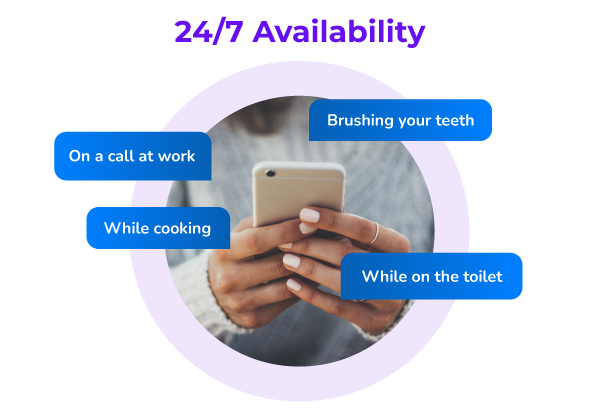
Customers want fast access to support and information. PWC report that nearly 80% of Americans say speed, convenience, and knowledgeable help are the most important aspects of a positive customer experience. A remedy to lack of availability, GenAI-fuelled chatbots offer instant answers to customer queries and speedy solutions to customer problems. AI can quickly identify, categorize, and solve customer issues. For example, unlike their human counterparts, AI chatbots have the ability to effectively monitor website and in-app activity for customer issues 24/7.
2. Agents' Assistance for Effeciency and Productivity
AI can reduce workload and automate menial, time-consuming tasks for your customer service teams. According to ZDNet:
81% of the companies use AI to gather preliminary information
75% of companies use AI to automate the handling of routine customer issues
74% use AI to classify customer problems
With AI, customer service reps no longer need to spend hours resolving basic customer issues that can easily be solved with technology. Instead, AI can quickly handle basic tasks and reroute customers to service reps when they need solutions to more complex problems. Additionally, GenAI enables agents to easily switch in languages. Making communication in a non-native language not only possible, but even grammatically correct. This shift in focus will free up to 50% more time for employees to engage in creative problem-solving (Gartner). Driving customer-centric innovation and creating unprecedented business value.
As such, AI chatbots free-up agents’ time – this enhances both efficiency and productivity and enables your team to focus on the more fulfilling aspects of their job. This both improves morale and reduces employee turnover.
3. Meet Your Customers' Needs
The businesses with the best customer service always consider the different needs and preferences of their key customer segments. Millennials and Generation Z do nearly everything on mobile – from paying their rent to ordering pizza. The smartest companies consider how the user journey for these important demographics needs to be optimized for mobile-first customer service interactions.
TechSee note that both Millennials and Generation Z want self-service customer service options and real-time responses via smart devices. In comparison, Baby Boomers typically prefer to speak to customer service reps on the phone. AI, combined with in-person and onthe-phone support, helps cater to every kind of customer preference.

In addition, conversational AI often provides the more human elements of customer service that consumers crave – without the long wait times that often go hand-in-hand with phone calls to customer service teams. As IBM note, natural language processing (NLP) and machine learning enable conversational AI to process, understand, and respond to customer conversations in a natural way.
4. GenAI for a Frictionless Customer Journey
Research from Dimension Data highlights that although 58% of companies agree that data and analytics will enhance the customer journey, 64% still don’t have data analysis capabilities that combine data from every channel. A seamless customer journey begins with an omnichannel customer service solution that reduces friction.
GenAI does away with the need to discuss an issue with multiple customer service reps – this reduces irritation and friction for consumers. When utilized as a key component of an omnichannel customer service solution, GenAI passes along all relevant data to customer service reps – via online chats or phone calls. This means that customers don’t have to explain their problems again and again to different customer service reps. Thus, GenAI can help provide a seamless, effortless, and integrated experience across every channel.
You can also use data derived from artificial intelligence to fuel a more complete picture of key customer segments. You can use GenAI to collect insights into the changing needs and frustrations of customers. In addition, you can also utilize AI to provide comprehensive data on the non-linear ebb and flows of the user journey. Rich data makes for smarter, more agile customer-service solutions across every channel.
5. Choose Cost-Efficient, Inherent Scalability
Scaling your customer service team is expensive. From hiring and onboarding costs to sizeable salaries and benefit packages. In comparison, it’s far faster and cheaper to scale with additional infrastructure that supports your current customer service offering.

As IBM highlight, the innate scalability of conversational GenAI is particularly helpful during sudden spikes in customer support demands, such as during the festive season, or when products expand to new geographical markets.
Impact on a Company’s Bottom Line
Reduced wait times that improve customer satisfaction and retention rates, the automation of repetitive customer service interactions, and an unbeatable capacity for cost-effective scalability. What do the benefits of conversational AI mean for a company’s bottom line?
The Watson Blog states, “Businesses spend $1.3 trillion on 265 billion customer service calls each year.” They add that AI offers a drop in per-query cost from $15-$200 (with human agents) to $1 (for virtual agents). Furthermore, Juniper Research reports that chatbots save companies an estimated $165 million each year. Adding that chatbots can cut a company’s operational costs by up to 30%, it has potential for a huge impact on your bottom line (Smallbizzgenius, 2020). According to Gartner, thirty-eight per cent of leaders see improving customer experience and retention as the primary purpose of initiatives to deploy applications trained on large language models, while 26% highlight revenue growth.
Improve Your Customer Service with GenAI
Curious to see how Gen AI can impact your customer service? From 24/7 availability to unlimited scalability, conversational AI promises several benefits that can revolutionize your current customer service solutions. In summary, these are the five notable benefits described:
24/7 customer service – solving the ‘availability problem’
The ability to automate menial, time-consuming tasks for your customer service teams
The capacity to deliver customer service that best fits the expectations and wants of different customer segments
GenAI-powered data and analytics for a frictionless customer journey
Unlimited, cost-efficient scalability
Want to start using AI? CM.com can help you provide exceptional conversational-AI centric customer service to your customers with a generative AI chatbot. Turn customer conversations into valuable engagements with a self-learning chatbot. Create your own AI powered chatbot within the platform, no coding required.