 Back to blog

And honestly? Some of the demos are incredible.
Tools like Claude, Cursor and Lovable are fundamentally changing how software gets built. What once took months can now be prototyped in an afternoon. Need a festival event app? Generate it. Need a schedule page? Prompt it. Need sponsor banners, push notifications and a branded interface? Done before lunch.
At CM.com and Appmiral, we’re big believers in AI ourselves. We use it across development, support, operations and fan engagement. We’re not here to argue that AI is overhyped.
But live events have a brutal way of exposing the difference between software that looks impressive in a demo and software that survives operational chaos. Because building screens was never the hard part. Surviving festival weekend is.
The dangerous illusion of AI-generated event apps
The dangerous part about AI-generated event apps is that they often look finished long before they’re production-ready. That’s what makes them seductive.
A polished prototype creates the illusion that the hard work is done. In live events, the hard work starts after the demo.
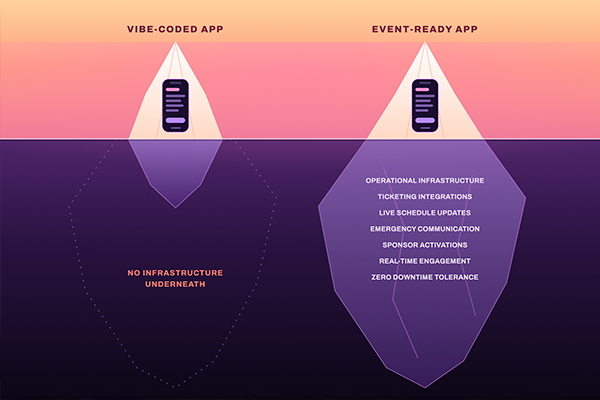
Because once 30,000 fans walk through your gates, your app stops being “an app.” It becomes a key channel in your operational infrastructure. It carries schedule updates, emergency communication, sponsor activations, ticketing integrations, artist changes and live fan engagement simultaneously, all under pressure, all in real time, with no tolerance for downtime.
All simultaneously.
All under pressure.
All in real time.
With no tolerance for downtime.
A banking app can recover from an outage overnight. An event or festival app gets one shot. There’s no restart button when the crowd is already inside.
Live events are hostile environments for software
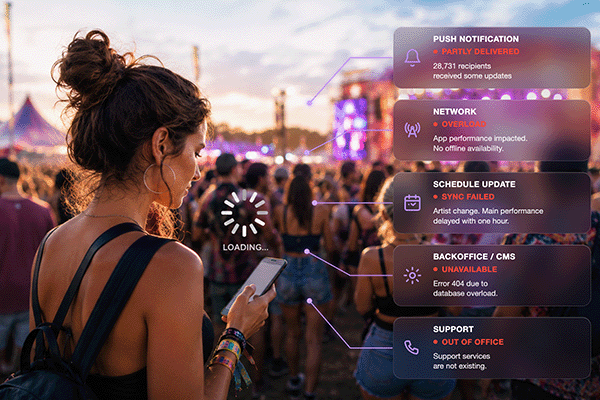
This is the part the current AI app-building hype largely ignores: live events are hostile environments for software.
Cell networks collapse under crowd pressure. Schedules change minutes before gates open. Artists miss flights. Rain destroys timelines. Security incidents happen without warning. And while all of that unfolds, tens of thousands of fans still expect the app to work flawlessly.
A duplicated push notification to 30,000 attendees is not a “small bug.” A delayed schedule update during a stage change is not “minor latency.” These are operational incidents that directly affect crowd movement, visitor safety and on-site coordination in real time. Because when operational pressure peaks, response time suddenly matters more than a beautiful frontend.
In our 17 years in the live events industry, we’ve seen countless moments where real-time communication became mission-critical. From dangerous weather conditions and overcrowded stages to harmful substances circulating at events, crisis communication through the event app can directly impact crowd safety and operational control.
That’s the part most AI-generated app conversations still underestimate. AI lowers the cost of building software. It does not lower the cost of failure. If anything, the easier software becomes to generate, the more valuable operational experience becomes.
The hard part starts after the prototype
Most organizations still underestimate what it actually takes to run a live event app at scale.
Even getting an app published is operationally complex. App Store approvals, SDK compliance, Accessibility guidelines, emergency fixes and last-minute review issues all happen against a completely immovable deadline: opening day.
A prototype generated on Friday afternoon may look impressive. Getting a stable festival app approved, deployed and operational three days before gates open is a completely different challenge.
And then the real pressure begins...
At Appmiral, years of running live events have shaped the parts of the platform that rarely show up in demos but matter enormously in reality. Things like offline-capable experiences during overloaded networks. Real-time timetable control during unexpected artist changes. Scalable push orchestration during crowd moments. Operational dashboards for support teams. Sponsor activation systems that continue functioning under live traffic spikes.
Those lessons don’t appear in screenshots. But they absolutely appear during festival weekend.
The modern event app is no longer just an app
What also gets lost in the current AI conversation is what a modern festival event app has actually become.
The strongest event organizations no longer think of their app as a weekend utility. They think of it as a connected fan engagement platform that links news, event info, ticketing, CRM, marketing automation, on-site payments and sponsorship activation into one continuous ecosystem.
Every interaction inside the app matters. A saved performance, a tapped sponsor offer or a clicked push notification becomes first-party audience data that powers personalization, segmentation, loyalty and future engagement long after the event itself ends.
The app is no longer just part of the experience. It’s the connective digital layer between the analogue event and the long-term customer relationship.
The future is AI-powered. Not AI-replaced.
To be clear, this is not an argument against AI in event technology. It’s the opposite. We believe AI will fundamentally reshape live experiences through intelligent personalization, automated support, operational automation and real-time audience engagement. That’s exactly why we’re building AI in all the CM.com tooling, including our very own Agentic Studio HALO.
Not as another AI wrapper generating mockups, but as an operational AI layer for multiple industries like e-commerce, retail, finance, … AI that can support your customers during key moments, automate engagement flows, surface operational insights in real time and help internal teams react faster under pressure. Typical usage here is Customer Service and Support.
AI that operates experiences. Not just prototypes them. Because the future of event technology is not AI-replaced platforms. It’s AI-powered operational platforms.
The real question for festivals, sports clubs and venues
The question is no longer whether AI can build a mobile app. Of course it can. The real question is who you trust when the event begins.
Because when 30,000 fans open your app simultaneously, nobody cares which prompt generated the code. They care whether it holds. And that’s the difference between vibe coding and mature industry solutions. One creates mainly modern looking prototypes. The other survives festival weekend.