
previous icon Back to blog
Jul 09, 2021
6 minutes read

5 Tips to Build the Best Chatbot

A growing number of companies are discovering the benefits of chatbots. Unfortunately, there are also a number of pitfalls, which may prevent your chatbot from providing the most optimal experience. With the tips in this article, you'll create a successful chatbot.

Brechtje van Houtum
Brechtje van Houtum,
Content Marketer

Build a genuinely effective chatbot? That's not an easy thing to do. Although the technology may be easy, you have to think about the concept carefully. There is nothing more frustrating than a bot that fails to help you. For example, by not understanding you, or giving incomplete or irrelevant answers. These five tips will guide you on your way to building a bot that truly helps your customers. 

1. Have a solid strategy in place

Are there plans for a chatbot? A good starting point is the "why" question. Why do you want to start using a chatbot? What is the goal? Consider whether a chatbot is the right means to achieve your goals.  

Forrester's research shows many companies are deploying bot technology for the wrong reasons. These include companies wanting to go along with the hype, expecting fewer contact moments, or wanting to replace service staff with a bot. Not only does this fail to have a positive effect on the bot's performance, it also jeopardizes the customer experience. Therefore, make a good business case. Don't focus on one KPI, such as cost savings, but consider all aspects of customer contact. 

Think forward, but start small. A chatbot is often part of a larger transformation. Based on the phase you are in as a company, decide how and what to automate. Start in a smart way, scale up when possible. For example, start with a chatbot on your website and later expand it to different channels.  

2. Fuel your chatbot with data 

The "why" question is naturally followed by the "what" question. What can customers do with your chatbot? What can they do with the bot? Or what questions can it answer?  

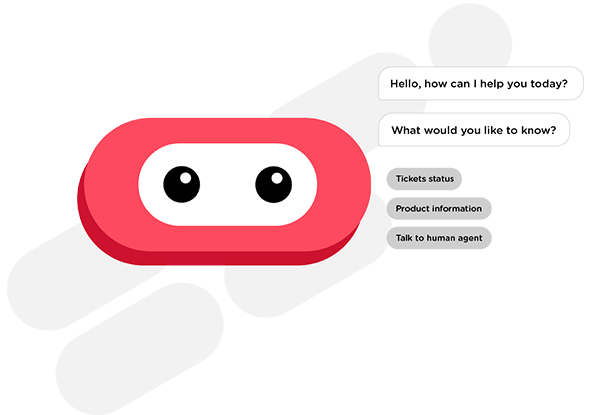
To perform, a chatbot requires input. The easiest variant is a Scripted Chatbot. You set up a flow yourself, which the customer follows. It's really a closed dialogue. The bot offers choices based on preset rules and the customer's input. Advanced bots offer more possibilities. You construct full open dialogues, which you can optimize based on performance with the help of AI technology. The AI bot not only learns from your input, but also from customer queries. Integrate the technology with your ERP, CRM or contact center systems and databases to create a personalized experience. As a first step, you can enter the 100 most frequently asked questions and answers, or connect the bot to your customer data.  

An advanced AI bot, with sufficient data and the necessary functionalities, can do much more than just answer routine questions. A customer is genuinely being helped within the conversation. AI prevents the question from not being recognized, avoiding incomplete or irrelevant answers. Recognizing the customer, verification, handling transactions, and executing tasks: a competent chatbot can do it all. Think about a status update of your package, or delaying your payment.

Make it clear to your customer what your bot can and cannot do, to prevent disappointment.   
DGP chatbot human agent questions

3. Personalize conversations

But don't get too personal. For many people using messaging channels is still something they do with friends and family. You do want to talk in a similar way, but not too friendly. Choose the right tone of voice, appropriate for your company. Let the conversations flow naturally. Use brief, understandable sentences. When a customer contacts you, the most important thing is that he or she is helped well, in a way that is convenient for them. Straightforward language helps.

As a customer, you don't want to have to provide too much information. If you've given your name and email address, you expect the rest of your data to be known as well. To handle personal matters, more data may be needed. Make sure the chatbot can access the data and recognize and authenticate the customer. By integrating your systems, for example with your Customer Data Platform, your chatbot can access the full customer profile. This way, it knows more than just the name.  

Speaking of names, do you already have a name for your chatbot? This gives your bot an identity, making it more personal.  

4. Taking chatbot to Live Chat 

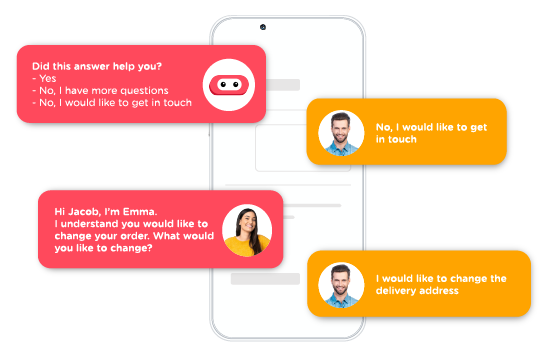
Sometimes a bot can't help you. Or you simply don't want to talk to a chatbot. Ensure an easy and quick hand-over to or take-over by an employee. Ask if your customer is being helped well, or wants to be re-routed. For both the employee and the customer it is beneficial if the employee can see the conversation. With the right customer service tooling, you have insight into every conversation, and into the complete customer profile. This way you know exactly how you can assist the customer even better.  

Never compromise on the quality of customer contact. Give your customer multiple options to contact you. A bot is convenient, but for several urgent, emotional, or complex service questions, human input is sometimes necessary. Chatbots are also used to reach out to a customer service representative. If a customer asks the bot about contact options, provide them with a full list of possibilities. Consider the phone number, but be transparent about when and how you can best be reached. Do you only deploy your bot outside of business hours? Then tell your customers when they can speak to an employee.  

Combining bot and personal support from your service team will make your service even better. Not only for your customer but also for your company.  
ai-agent-takeover

5. Learn and innovate 

A chatbot can always be improved. Review and analyze conversations to learn from them. Where does a customer get stuck? Is the bot giving the right answer in all cases? With the right insights, you can improve your conversations. Implement good reporting options. AI technologies present opportunities for improvement based on customer input.  

Dare to innovate. Think about the next step, to prepare for the future. How can customers reach you at the moment? Would a bot work via WhatsApp? Or perhaps as a voicebot, when customers call? Ask your customers for feedback. How would they like to interact with Conversational solutions? You learn from feedback.  

Keep testing, keep learning.  

Offer personalized service

Automate in a safe and considered approach. Your chatbot can't do it alone. Human input and support are still needed to provide good service. By being transparent about what your customers can and cannot do with your bot, you avoid frustration. Continue to provide personalized, good service - whether via a bot or via your service team.  

Want to know more about intelligent chatbots that can genuinely help your customers? Contact us or read more about Conversational AI.


Create an AI bot? Discover Conversational AI Cloud

Was this article interesting?
Share it!
Brechtje van Houtum
Brechtje van Houtum,
Content Marketer
logo linkedin icon

Whether it’s developing content strategies or creating social media content, Brechtje is eager to contribute. She spreads CM.com’s message far and wide, stays on top of cutting-edge tech developments, and champions a 'customer first' philosophy.

Latest Articles

blog-conversational-christmas-engagement
Nov 25, 2025 • Messaging

Convert Conversations This Christmas: 5 Use Cases

The holiday season is almost here, and it comes with the perfect opportunity to connect with customers in a personal and meaningful way. Messaging channels like WhatsApp, RCS, and SMS can help you create an unforgettable customer experience this Christmas. In this blog, you’ll discover how these channels can boost satisfaction and drive sales during the busiest time of the year.

Ai governance
Nov 14, 2025 • AI

AI Is Getting Smarter and More Independent. How Do You Stay in Control?

More and more companies are rolling out AI agents that go far beyond generating content or answering simple questions. They handle customer requests, update systems, trigger workflows, and even complete transactions. This brings speed, efficiency, and relief from manual, repetitive work. But once AI starts doing instead of merely assisting, something fundamental shifts. You need more than clever technology. You need a clear way to stay in control of what it does, why it does it, and the limits within which it can operate. This is where AI governance comes in. Not as a tick-box compliance layer, but as a practical foundation that keeps AI predictable, explainable, and safe as it becomes more autonomous.

blog-black-friday-customer-retention
Nov 13, 2025 • AI

From Casual Consumers to Loyal Fans: How to retain customers after Black Friday

Black Friday is a huge shopping event, drawing crowds of eager shoppers hunting for deals. But once the rush fades, the real challenge begins: turning one-time shoppers into returning customers. Customer retention is vital for long-term success, and the period after Black Friday is the ideal moment to turn short-term excitement into lasting relationships. In this blog, you’ll learn how to keep customers engaged and coming back long after the rush is over.

AI-now and future
Oct 28, 2025 • HALO

The Business Impact of Agentic AI: now and in the future

Imagine customer inquiries being answered 24/7 without wait times, automatic updates on delayed orders, or fully digital shopping assistants guiding customers from browsing to purchase. These are just a few examples of what Agentic AI can achieve. In this article, CM.com’s Marketing Lead AI & SaaS, Sander Harryvan, and Product Marketer, Tom Faas, share their insights on where businesses currently stand in adopting Agentic AI, what the next phase looks like, and why Agentic AI will have a profound impact on the way we do business in the coming years.

3 types of AI
Oct 15, 2025 • AI

Unleashing the Power of AI: How Generative, Agentic, and Predictive AI Are Transforming Customer Experience

Artificial Intelligence (AI) has been in development for decades, but the way we use it today has changed dramatically. With the advent of ChatGPT and other applications, AI has suddenly become tangible for the general public. While it was previously used primarily for specific, often invisible applications (think fraud detection in banking or predictive maintenance in industry), it now actively assists in content creation, enhancing customer experiences, and streamlining processes. Within customer experience, three forms of AI are particularly relevant: generative, agentic, and predictive AI. In this article, we’ll break them down and explain how to leverage them effectively.

halo-insurance
Oct 10, 2025 • AI

From Claims to Customer Questions: How AI Agents Help Insurers

The insurance industry is known for its complex processes and heavy administrative load. Fragmented communication, outdated systems, and complicated policy conditions mean that finding the right information or processing changes often takes far longer than it should. AI agents can change that. They answer questions, pull real-time data from internal systems, and seamlessly trigger processes.

blog-halo-real-estate
Oct 02, 2025 • AI

AI Agents in Real Estate: Streamline Inquiries and Deliver a Better Buyer Experience

In today’s competitive global real estate market, agencies are flooded with inquiries on listed properties. Buyers expect instant answers about availability, pricing, and next steps — often outside office hours. For real estate agents, this creates a heavy workload: handling repetitive questions, scheduling viewings, and informing disappointed buyers when a property is already sold or oversubscribed. Without automation and smart workflows, agencies risk being overwhelmed, leading to frustrated buyers and missed opportunities for meaningful interactions. HALO, CM.com’s AI-powered engagement platform, helps real estate companies streamline these processes. AI agents work 24/7, provide human-like responses, and handle routine tasks instantly. This frees agents to focus on what matters most: building relationships and guiding serious buyers through the transaction.

blog-ai-agents-live
Sep 23, 2025 • AI

How AI Agents Are About to Transform the Music and Events Industry

The live events industry - from sports matches to festivals and concerts - is under pressure. Fans demand more, technology evolves constantly, and internal teams are stretched thin. In this shifting landscape, AI agents aren't here to replace people, but to amplify them - bringing structure, speed, and clarity where it's needed most.

Implementation checklist for AI agents
Sep 23, 2025 • AI

Your AI Agent Implementation Checklist

AI agents aren’t just shaping the future they’re transforming how companies serve and connect with their customers right now. From answering service requests instantly, to guiding shoppers through a purchase, to spotting upsell opportunities in real time, the question is no longer if you should implement AI, but how quickly you can put it to work.

Is this region a better fit for you?
Go
close icon