previous icon Back to blog
Jan 17, 2022
6 minutes read

Six Things Customer Service and Retail Brands Get Wrong About Customer Loyalty

Some believe that you can earn loyalty by ‘delighting’ customers. Some say a ‘positive emotional experience’ works best. Others say we shouldn’t use the term loyalty at all, because it’s misleading, and no one can ever really be ‘loyal’ to a brand anyway. Is the truth out there?

When you talk to one of our Customer Service Experts, they will probably introduce you to our 'Three Principles of Great Customer Service':

  1. To reduce customer churn: meet customer expectations and solve problems in one friendly conversation.

  2. To build loyalty: continuously reduce your customers' effort throughout their shopping experience.

  3. To optimize customer experience: actively gather and share knowledge about customer needs and expectations across your company.

Rooted in strong, commercial business logic, these principles help team leads manage stakeholder expectations about where customer service should (and shouldn’t) be focusing on. They help identify where service can add the most value. And where it can have a maximum financial impact.

As you might expect, the word loyalty crops up a lot in those principles. Down below are six beliefs we think everyone should know about customer loyalty.

1. Customers cannot actually be 'loyal' to a brand

“From the perspective of consumer psychology, the notion of customer loyalty makes almost no sense” — Philip Graves, author, Consumer.ology


In this report, consumer behavior expert Philip Graves explains that in psychological terms, being loyal is just not something you can apply to humans and brands.

Loyalty is an emotional restraint that keeps humans within the ‘safety of the herd’. When we don’t act in accordance with social ‘rules’, we feel shame and guilt. Without shame and guilt, loyalty cannot exist. And no one should ever really believe that consumers feel so emotionally bad at leaving your brand that they will experience shame and guilt.

So, while customers can indeed keep on using your products, this is not actually ‘loyalty’. Graves believes that repeated use is basically about how good your product is.

All this is worth keeping in mind. The word loyalty will not disappear from the business lexicon any time soon, but it is always good to be clear on what we are actually talking about.

On that note…

2. Loyalty is best broken down into two separate buckets

Most people think of loyalty as one single big thing. But if you are serious about impacting it, and want to employ the right strategies to do that, it is best to think about loyalty in two distinct buckets:

  • Positive loyalty gains: reasons people stay with your brand

  • Disloyalty (also called ‘churn’): the reasons people leave your brand

Once you split out loyalty into these two buckets it becomes easier to manage, and communicate about loyalty. It also helps you look at certain claims with a healthy amount of skepticism!

3. Poor customer service is the biggest cause of disloyalty (churn)
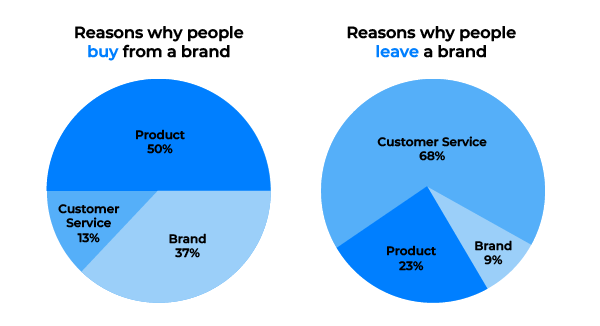
engage blog about loyalty and if people want to buy or leave from your brand

Source: Customer Contact Council

While online shoppers buy from you because of your product or brand, they most often leave because of poor customer service.

Yes, it’s true. Customer service is typically the single biggest contributor to brand disloyalty. This is why the most fundamental role of customer service should always be to prevent customers from leaving.

The first priority of your team should be to address speed, friendliness, and effectiveness in meeting customer expectations. Without this in place, your marketing department could be fighting a losing battle.

4. Satisfaction and high spending are not indicators of loyalty

"Between 60 and 80 per cent of customers say they are ‘satisfied’ or ‘very satisfied’… just before leaving" — Harvard Business Review


Many retail brands see customer satisfaction as a great indicator of customer loyalty. But as Frederik F. Reichheld, the inventor of NPS (Net Promoter Score) established himself many years ago, satisfaction is not an indicator of loyalty. This does not mean that satisfaction is unimportant to measure. Satisfaction measures a customer’s attitude towards their latest interaction with your brand — nothing more.

Oh, and your highest-spending customers are probably cheating on you, too. Many retailers believe that a high average spend is an indication of brand loyalty. But as this McKinsey study found, close to half of spending of disposable income by a company’s best customers goes to other retailers in the same category. Meaning: your high-spending customers are not necessarily loyal.

The lesson to take from these examples is:

  • Correlation is not causation. Be wary of making connections between actually unrelated data

5. 'Delighting' customers will not get you loyalty gains

Exceeding customer expectations will bring you a lot, but probably no increase in loyalty.

engage blog about loyalty and the roi

Source: Customer Contact Council

Plus, by aiming to ‘delight’, you run the risk of raising expectations for their next interaction with you, which will make them harder to meet! Instead, in service, focus on understanding and meeting basic expectations — this is both tough enough in itself and offers an excellent return on investment.

6. Reducing customer effort is the clearest way to make loyalty gains of all

The bottom line is that, above everything else, customers want their shopping made easier — and customer effort and loyalty benefits are insanely correlated.

The image below shows the differences between customers experiencing low effort throughout the journey vs. those experiencing high effort.

engage blog about loyalty and low high effort with buying from your brand

Source: Customer Contact Council

From all the data we have seen, reducing customer effort is the most beneficial thing a retailer can do to meet customer needs — and generate loyalty benefits.

So … think carefully, for example, before redirecting all customers en masse towards self-service and FAQs. That could be killing loyalty at the source.

How is your customer service department contributing to loyalty?

Today, retail brands are facing serious competition. Shopper expectations are still rising. And many brands are still optimizing their mix of bricks and mortar and online and refining their business model and operations as business grows.

In this context, the difference between the cost of acquiring a new customer (versus the cost of making sure existing customers stick around) comes sharply into focus.

With the right tools, you can make sure that customer service plays its full and proper role to maximize its contribution to your company’s growth.

*This article was originally published on robinhq.com

Find Out More About Customer Service

Was this article interesting?
Share it!
CM.com
connects tens of thousands of companies with millions of consumers via their mobile phone each day. Behind the scenes, from our innovative platform, CM.com makes sure companies can use these millions of messages, phone calls and payments to become part of people’s lives.

Latest Articles

blog-black-friday-customer-retention
Nov 13, 2025 • AI

From Casual Consumers to Loyal Fans: How to retain customers after Black Friday

Black Friday is a huge shopping event, drawing crowds of eager shoppers hunting for deals. But once the rush fades, the real challenge begins: turning one-time shoppers into returning customers. Customer retention is vital for long-term success, and the period after Black Friday is the ideal moment to turn short-term excitement into lasting relationships. In this blog, you’ll learn how to keep customers engaged and coming back long after the rush is over.

3 types of AI
Oct 15, 2025 • AI

Unleashing the Power of AI: How Generative, Agentic, and Predictive AI Are Transforming Customer Experience

Artificial Intelligence (AI) has been in development for decades, but the way we use it today has changed dramatically. With the advent of ChatGPT and other applications, AI has suddenly become tangible for the general public. While it was previously used primarily for specific, often invisible applications (think fraud detection in banking or predictive maintenance in industry), it now actively assists in content creation, enhancing customer experiences, and streamlining processes. Within customer experience, three forms of AI are particularly relevant: generative, agentic, and predictive AI. In this article, we’ll break them down and explain how to leverage them effectively.

blog-ai-agent-creation
Jul 25, 2025 • AI

The Agentic AI Playbook: Unlock Ideas for Your New Digital Colleagues

In a world where AI agents are becoming the norm, the real challenge isn’t understanding what they can do but imagining how they can work for you. AI Agents are more than just automation tools; they’re customizable digital colleagues, ready to take on roles tailored to your unique business needs. The possibilities are endless, but it’s not always easy to know where to start. It's time to spark your creativity. From streamlining niche processes to handling tasks you didn’t even realize could be automated, AI Agents can integrate seamlessly into your team. Here are some fresh ideas to inspire your next digital colleague.

Successful Debt Collection With Consumer-Friendly Upgraded SMS
Apr 24, 2025 • Customer Experience

Successful Debt Collection With Consumer-Friendly Upgraded SMS

Debt collection can be a tough industry. Outstanding, late, or unpaid debts are tricky to manage and solve, and strict (security) regulations make the work complicated. On top of that, the industry has a reputation problem - many consumers see debt collectors as aggressive or unapproachable. But how does one make debt collection more efficient, more transparent, and more consumer-friendly?

blog-interview-halo-customer-service
Mar 20, 2025 • Chatbots

Chatting with the Near Future: AI's New Role in the Customer Experience

AI innovations in customer service are emerging more rapidly than ever before, especially with the latest addition of Agentic AI and it’s AI Agents. We spoke with Roel Jansen, our Head of Commerce of our Engagement Platform, on how these AI advancements are transforming customer interactions and enhancing the experience. With Roel's expertise and vision, discover the future of customer service and what it means for businesses today. Whether you're an AI enthusiast or just curious about the future, you won't want to miss these engaging insights!

Live 5 ways to optimize customer service in leisure
Feb 14, 2025 • Customer Experience

Make Your Contact Page Irresistible: 8 Essential Tips for Improved Customer Service

Your contact page is the ultimate business card for your customer service and provides a direct connection to your customer service team. It's a crucial part of the customer experience where you have the chance to significantly enhance the experience right away! To make this happen, the page needs to be well-designed. In this blog, you'll discover 8 steps you can take to make your contact page irresistible!

halo
Feb 06, 2025 • CM.com

Agentic AI Agents: Helping You Get Things Done

Looking for a smart and capable employee that never sleeps? A little helper that can take over all your menial and repetitive tasks to make your life a little easier? One that will continuously learn and improve itself to keep assisting you the best it can? This may sound like a dream (and an unrealistic one at that), but it's much closer to reality than you might realize! Discover Agentic AI!

blackfriday-2024-blog-featured-global
Oct 14, 2024 • AI

The Art of Simplicity: Helping Your Customers Make Quick Decisions This Black Friday

Black Friday 2024 is just around the corner, bringing with it a great opportunity for retailers to maximize their sales. However, standing out in such a competitive event isn’t easy. Consumers expect attractive offers, fast deliveries, and top-notch customer support. In this article, we’ll show you how to simplify the purchasing process during Black Friday, optimizing everything from promotions to logistics and 24/7 customer service. Discover the best strategies to ensure a seamless experience and increase customer loyalty. Don’t fall behind this Black Friday!

Education Technology
Jul 12, 2024 • Mobile Service Cloud

How Do You Create a Tagging System for eCommerce Customer Service?

Once your customer service team has more than three employees, it is difficult to explain to the rest of the organization what the customer service conversations are about. Adding tags to service conversations is a good method to tackle that problem.

Is this region a better fit for you?
Go
close icon