
A chargeback needs a response. A festival needs payments to continue when connectivity drops. A travel business needs multi-currency settlement. Or a business wants to introduce a payment flow that doesn't fit the standard setup.
In each case, what happens behind the payment can be just as important as the payment itself. That's when the infrastructure behind your payments starts to matter.
The way your payment infrastructure is set up can affect how quickly you can respond to issues, how much flexibility you have, and how easily you can adapt as your business evolves.
So, what is transaction processing, and why does the setup matter for your business?
How transaction processing fits into the payment chain
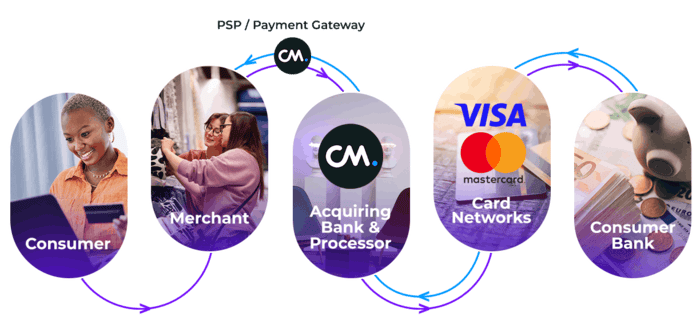
A card payment involves several parties, including your payment service provider, processor and acquirer, card networks such as Visa and Mastercard, and the customer's bank.
When a customer makes a card payment, the transaction needs to travel through this chain before the payment can be approved and ultimately settled. The payment service provider provides the payment solution and connects the merchant to the payment infrastructure. The processor handles the technical processing and routing of the transaction, while the acquirer enables the merchant to accept card payments and connects to the card networks. The card networks route the transaction between the acquirer and the customer's bank, which checks whether the payment can be approved.
Who handles these roles?
For many businesses, these roles are spread across several separate parties. That can mean multiple contracts, reporting systems, points of contact and dependencies when something needs to change.
These roles don't always have to be handled by separate providers. CM.com, for example, combines payment services with transaction processing and acquiring, working directly with Visa and Mastercard. This means more of the payment chain is managed by one provider, rather than being spread across multiple parties.
 So, what does this mean in practice? Let's look at a few situations where the setup behind your payments can make a difference.
Transaction processing for different business needs
Consider a busy festival where thousands of visitors need to keep paying even when connectivity is unreliable. Perhaps you're a travel business that needs a specialized payment flow, an international retailer that needs multi-currency settlement, or a hospitality business that wants Dynamic Currency Conversion.
In a fragmented setup, new capabilities may require several companies to agree before anything can change. The more parties involved, the more dependencies there can be when a payment setup needs to change.
Also, an external acquiring partner can decide it no longer wants to support a certain business because of the risk involved. The payment service provider then needs to find another acquiring route or establish a direct relationship with the card networks to continue supporting those businesses.
It shows how decisions made elsewhere in the payment chain can have a direct impact on the businesses relying on it.

What changes when CM.com handles transaction processing?
CM.com manages transaction processing directly, working with Visa and Mastercard rather than relying on external acquirers and processors for these parts of the transaction.
Take chargebacks and disputes. When information passes through several organizations, a business may hear about a dispute only after it has travelled through the payment chain. With CM.com handling transaction processing directly, CM.com has greater visibility into the processing flow and can notify businesses more directly, giving you more time to respond.
Or take flexibility. Because CM.com works directly with the card networks, CM.com can support businesses when they need something outside the standard payment setup. This can include capabilities such as offline payment processing, Dynamic Currency Conversion, multi-currency settlement and specialized payment flows.
The benefit isn't that every request automatically gets a yes. It's that there are fewer dependencies between your business and decision-makers.
Benefits of combining payment services and transaction processing
When payment services, processing and acquiring are handled through one provider, businesses can simplify how they manage their payment infrastructure. Instead of coordinating across several parties, you can have:
One contract and integration
One point of contact
Unified reporting
Less reconciliation complexity
More direct visibility into disputes and transaction issues
Greater flexibility as your payment requirements evolve
In practice, this can mean fewer handoffs when something goes wrong, faster access to information, and more flexibility when payment requirements change.
Managing transaction processing directly also gives that payment service provider greater visibility into transaction flows and risk settings, creating opportunities to optimize payment performance, including authorization rates.
Fewer external parties can also mean fewer layers of payment costs, depending on your setup, transaction volumes and markets.
Transaction processing with CM.com
CM.com brings together payment services, acquiring and transaction processing for online and in-person payments.
For businesses in retail, travel, events, hospitality and public services, that means one partner supporting more of the payment journey, behind every payment and every moment that follows.