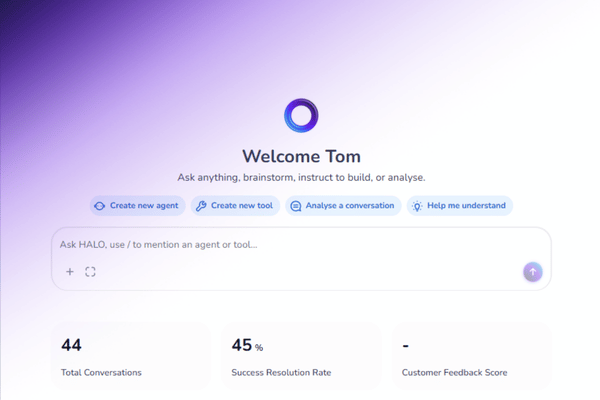


AI agents do more than just answer questions
AI agents are becoming increasingly capable. Beyond answering questions, they can retrieve customer data, reschedule appointments, process requests, and trigger actions in back-end systems. This is exactly what HALO AI Agents do.
This makes them far more valuable, but it also means privacy, security, and compliance quickly become key considerations.
This is especially true for larger organizations. Before an AI agent can go live, legal, security, privacy, and procurement teams usually need to review it.
However, this does not mean your project has to stall for months. For most customer engagement AI applications, you simply need to be able to answer four key questions. We will look at each question and explain how we handle it in HALO, so you do not have to build these compliance features yourself.
A quick overview: what the AI Act requires
The AI Act entered into force on 1 August 2024 and is being phased in gradually. The regulation focuses on the application rather than the underlying technology. The higher the risk associated with the use case, the stricter the requirements.
There are four broad categories:
● Prohibited practices. This includes social scoring or emotion recognition in the workplace.
● High risk. AI systems used to make decisions about credit, insurance, employment, or access to essential services. These are subject to the strictest requirements.
● Limited risk. Systems that interact directly with humans, such as chatbots and voicebots. These are primarily subject to transparency obligations.
● Minimal risk. No specific obligations.
Most customer service AI agents fall into the limited risk category. However, this changes if you allow an agent to make decisions regarding eligibility for services, credit, or employment. This brings us to the first question you need to answer: what exactly will the agent do?
For planning purposes, note that the high-risk requirements have been postponed. The AI Omnibus, which took effect on 27 July 2026, pushed these deadlines to 2 December 2027 and 2 August 2028. However, the transparency obligations under Article 50 did go ahead and have been in force since 2 August 2026. Anyone who heard that the entire AI Act was delayed was misinformed.
Additionally, the AI Act complements the GDPR rather than replacing it. If you process personal data, GDPR compliance remains fully mandatory. The AI Act also requires organizations using AI to ensure their employees have sufficient AI literacy to use these systems responsibly.
In practice, this comes down to four key areas for most customer engagement applications.
1. Do your customers know they are talking to AI?
The transparency obligations under the European AI Act have been in force since 2 August 2026. For interactive AI systems, the rule is simple: users must be informed when they are interacting directly with an AI system.
For a customer service AI agent, this means clearly stating at the start of a chat or phone call that the customer is speaking with an AI agent.
This does not require a twenty-line legal disclaimer. You simply need to be transparent about who or what is on the other end of the line.
This is not just about compliance; it also helps manage customer expectations from the start.
How this works in HALO
You can customize the welcome message for each channel and language, allowing you to manage notifications consistently across web chat, WhatsApp, and voice calls.
You can also hand over the conversation to a live agent at any time, complete with the full chat history. Within Agent Inbox, the AI remains in the background to assist the human agent, meaning the customer never has to repeat themselves. True transparency is not just about the initial disclosure; it is also about providing a clear path to human support when requested.
Furthermore, HALO analytics track which conversations the agent resolves independently and where handovers occur. This provides the clear documentation your privacy officer needs to verify exactly what your AI is doing.
2. What personal data are you sending to the AI model?
Customer service interactions naturally involve personal data.
This can include names, email addresses, or order numbers, and depending on the query, payment details, physical addresses, or other sensitive information.
This does not mean AI agents are prohibited from processing personal data. It simply means the GDPR applies to this processing. European data protection authorities explicitly recognize scenarios where personal data is processed during the development or deployment of AI models.
The real question is: what data does the model actually need?
If an AI agent only needs to determine customer intent, there is no need to send the entire customer profile to the large language model.
This makes data minimization, masking, and strict access controls essential. You also need clear policies on logging, retention periods, and data usage restrictions.
An AI agent should only receive the specific information required to complete its task.
How this works in HALO
We only use language models for inference, never to train models with your customer data. This is a strict policy, not just an intention. It is codified in our AI policy and contractually agreed with our model providers.
Data sent to a model is pre-processed and anonymized where possible, with personal data removal built directly into our data pipelines.
Additionally, a HALO agent operates solely on the specific context required for the task, retrieved via the integrations you configure. It never relies on sending a full dump of your customer database to a model.
To support your DPIA, we can show exactly what data goes to each model, in what format, and how it is processed. This is fully documented in our AI Resource Registry, which lists every AI model we use.
3. Where is your data processed?
With AI, it is not just about what data you process, but also where that processing takes place.
Many organizations therefore choose to keep customer data and AI processing entirely within Europe.
This does not mean the GDPR prohibits personal data from leaving Europe. Data transfers are permitted under certain conditions, such as when a country has an adequacy decision or when appropriate safeguards, like Standard Contractual Clauses (SCCs), are in place.
However, every additional data flow adds complexity to your architecture, supply chain, and compliance framework.
For organizations handling large volumes of customer data, keeping data within Europe is often the most straightforward approach.
How this works in HALO
Customer data remains within Europe. Our data residency requirements cover both storage and processing, and they are built into the deployment plan before any model goes live.
This pipeline extends beyond the language model to include speech recognition, conversation storage, logging, and monitoring. We document this entire chain for each model, including hosting environments and sub-processors, so you do not have to map out every link yourself.
This prevents every new AI project from triggering complex international data transfer assessments. You can find detailed compliance information for each of our services in our Trust Center.
4. What happens if someone tries to manipulate your AI agent?
Traditional chatbots were mostly limited to giving incorrect answers.
Modern AI agents, however, can execute actions, such as modifying orders, retrieving CRM data, or rescheduling appointments. This adds a critical security dimension.
A key risk in this context is prompt injection.
This occurs when a user inputs instructions designed to override the AI model's standard behavior. For example, they might tell the agent to ignore its system prompt, display unauthorized information, or perform restricted actions.
When an agent is integrated with other systems, a well-crafted system prompt is not enough.
You must restrict the tools available to the agent, verify user permissions, validate inputs and outputs, and apply secondary checks for sensitive actions. The principle of least privilege is vital here: grant the agent access only to the specific resources required for its role. This is also one of the primary security measures recommended by OWASP for AI agents.
Security must be built into the surrounding infrastructure, not just the AI model itself.
How this works in HALO
You define exactly which actions and system integrations are available to each agent. If an agent does not need to process refunds, it simply lacks that capability, and no clever prompt injection can bypass that restriction.
For sensitive or irreversible actions, you can keep a human in the loop rather than letting the agent decide autonomously. Our AI policy mandates human oversight for high-risk outputs, so this safeguard is built into our development process by default.
In addition, we conduct red teaming and stress testing before deploying models, monitor them continuously, and address AI-specific threats in our incident response process. All conversations and model actions are logged, allowing you to reconstruct any incident.
And then there are the rules that apply to your organization
While the AI Act and GDPR apply broadly, your sector may have additional requirements.
For healthcare organizations, NEN 7510 is critical for securing personal health information.
Financial institutions must comply with DORA, which regulates digital operational resilience and ICT risk management, including the registry of ICT third-party service providers. DORA has been in force since 17 January 2025.
Across multiple sectors, the Dutch Cybersecurity Act (the local implementation of the European NIS2 Directive) entered into force on 15 August 2026. It applies to over 8,000 organizations in essential and important sectors, introducing registration requirements, mandatory risk assessments, and incident reporting obligations. If this applies to you, your AI agent is considered part of your network and information systems, and your AI provider is part of your supply chain.
Government organizations must also adhere to the Baseline Informatiebeveiliging Overheid (BIO).
There is no single compliance checklist that fits every AI project.
However, the core principles remain the same: know what data you process, understand where it goes, restrict your AI agent's capabilities, and ensure you can demonstrate how you manage AI risks.
From experimental project to controlled AI system
This last point is exactly what legal, security, and procurement teams look for when reviewing your AI project.
They need more than verbal assurances that an AI solution is secure. They want to see a structured framework for managing security, privacy, risk, and accountability.
This is why CM.com holds the ISO 42001 certification, alongside ISO 27001, 27017, 27018, and 27701.
ISO 42001 is specifically designed for Artificial Intelligence Management Systems (AIMS). It establishes requirements for how organizations develop, deploy, monitor, and continuously improve AI. The standard evaluates AI governance, risk management, transparency, and accountability.
For us, this translates into concrete measures: an AI Governance Board that reviews risk assessments and deviations; an AI Resource Registry documenting every model we use, including data, tooling, and hosting; a structured process for reporting concerns and incidents with defined response times; and an annual review (or sooner if prompted by regulatory or technological changes).
This certification is not a rubber stamp that automatically guarantees compliance for every AI project. Your specific use case, data, and disclosures remain your responsibility.
However, it provides independent proof that AI at CM.com is not an isolated experiment. Instead, it is integrated into a controlled management system with established processes for responsible AI use.
This can make your discussions with security, privacy, legal, and procurement teams significantly easier.