

Why building your own looks so appealing
A knowledge base, a language model, and a developer to connect the two. In principle, that gives you an agent that can answer questions about your business. You see the first good answers and think: we can do this ourselves.
And you can. Existing APIs, frameworks, and managed services mean you do not have to develop everything from scratch. For a clearly defined task, your own solution can be a good fit. You make the technical decisions and depend less on a platform provider's priorities when you want to add functionality.
A platform offers a different set of advantages. You use capabilities that have already been developed and place some of the technical management with the provider. You pay for that, and you work within the platform's capabilities.
The decision is about which approach best fits the agents you want to deploy. A chatbot that searches a manual requires a different investment from agents that update orders, handle phone calls, and are managed by your customer service team.
Even answers from your knowledge base need more than a connection
Take 3,000 pages of company knowledge. Your customer asks a question for which a single paragraph is relevant. You want to find that passage quickly, without processing the entire document every time. That adds unnecessary time and cost and can introduce information that distracts from the answer.
Many solutions use RAG: retrieval-augmented generation. The system retrieves relevant passages and supplies them to the language model. How well that works depends on several factors:
Chunking: dividing knowledge into useful sections. If you split every 500 words, a return policy and an exception to it can end up in separate passages.
Embeddings: representing knowledge and customer questions numerically so the system can search by meaning. Customers do not have to use the same words as your documentation.
Ranking: evaluating the retrieved passages for relevance. Text on the same topic does not necessarily contain the answer to this particular question.
These techniques continue to change. Within a few months, better ways to search your knowledge may be available. When you build your own solution, evaluating and implementing those improvements falls to your team. With a platform, this is part of the work you want the provider to handle.
Even the knowledge base is therefore part of the build-versus-buy decision. The technology affects the quality of your service, even though your customer never sees it.
Channels, tools, and management add development work
As a customer service manager, you want customers to get good support through the channel they use. That requires capabilities that often are not visible in an initial chatbot demo.
Helping customers across multiple channels
An agent on your website is a good start. If you also want to deploy it on WhatsApp or RCS, it needs to handle different message formats and interactions, such as lists and carousels. Those interactions must connect to the same customer process. A platform lets you use existing channel integrations; with your own solution, selecting and coordinating those connections falls to your team.
Handling a natural phone conversation
Voice adds speech recognition, speech generation, and handling interruptions. Latency across the entire chain matters: finding knowledge, querying a system, and speaking the answer. Waiting a few seconds on the phone feels different from waiting in a chat window. A good text-based agent is not automatically a good phone agent.
Actually completing a customer request
An agent that explains your return policy takes less work off your team than one that also creates the return. That requires tools and system access. An API or MCP server makes the action available, but the right customer data, access permissions, and handling of failed actions determine whether the task is completed reliably.
Letting a team member take over
When an agent gets stuck, you want a team member to continue with the conversation and previous actions available. Otherwise, the customer has to start over. That handoff requires integration with your contact center software and workflows. The customer's experience also depends on the integration behind the agent.
Letting your service team make changes
Your policy changes, or you want to automate a new task. It matters whether your team can make that change itself or needs a developer every time. An accessible environment for managing agents, knowledge, and tools has operational value. If you build your own solution, developing that environment is another part of the work.
Understanding why a conversation goes wrong
The number of conversations does not tell you how many customers received good support. You want to see where they get stuck and trace the knowledge, tools, and system responses that led to the outcome. Those insights help your team make targeted improvements. Without logging and analytics, it is difficult to distinguish an answer problem from a knowledge or integration problem.
Improving agents without disrupting existing tasks
A change also needs to work in exceptional cases: missing data, an unclear request, or a system that does not respond. That requires repeatable tests. Model selection is part of this, too. At CM.com, we compare models on factors including answer quality, speed, and cost using CM-ServiceBench. The newest model is not automatically the best choice for your customers' questions.
Not every organization needs all these capabilities. But if you do want them, they belong on both sides of the comparison: what does the platform provide, and what would it cost to deliver the same service yourself?
The costs of building and buying
Building your own solution gives you control, but it takes development time to deliver the capabilities you need. The developer who builds an initial chatbot does not necessarily also have expertise in voice, channel integrations, and an effective management environment. The broader the deployment, the more work surrounds it.
Buying a platform can reduce that development work because you use existing capabilities. You still need to configure the solution, integrate systems, and prepare your knowledge and processes.
A fair comparison looks like this:
Consideration | Building your own | Using a platform |
|---|---|---|
Getting started | Your own development and integrations, using existing components where possible | Implementing and configuring available capabilities |
Ongoing costs | Team, models, hosting, maintenance, and support | Platform and usage costs, plus managing your own application |
Control | Your own architecture and development priorities | Your own configuration within the provider's capabilities and roadmap |
Time to results | Depends on your team and the scope of development | Depends on how well the platform fits your processes and systems |
Your developers' time is part of that comparison. What could they contribute to your own product or service over the same period? For a customer service organization, that can matter more than a difference in cost per model call.
Maintenance and ongoing development after launch
Development is moving so quickly that one component can fall behind while you are still completing the rest. New models, search techniques, and tool capabilities need to be evaluated. Your own systems and processes change, too.
You do not have to adopt every new technique immediately. But someone needs to understand which changes matter and be able to test and implement them. If you build your own solution, you organize that expertise yourself. With a platform, you place some of it with the provider.
At CM.com, we have spoken with enterprise organizations that initially built their own RAG solution and later decided to use a platform. Their first version worked, but the surrounding work and ongoing development turned out to be greater than expected.
That does not make those first good answers any less valuable. It does show why the investment after launch needs to be part of your decision.
What you can gain by building your own
Building your own solution gives you room to make technical choices that fit your organization. That can offer significant advantages:
Your own development priorities: you decide which functionality is added and when.
Extensive customization: you can support processes that available platforms do not adequately accommodate.
Your own technology and expertise: what you develop can become part of a product or service that sets you apart.
A suitable cost structure: at sufficient usage levels, building your own can be attractive, provided you include team and maintenance costs.
For a broad agent system, we see the strongest case for building when developing that technology is part of your core business or directly contributes to a differentiated service. For example, you may sell the system itself, or your product may have requirements that available platforms cannot meet.
That requires ongoing expertise, a multiyear budget, and a realistic scope. A large organization may be well placed to provide those. For a single, limited task, a smaller custom solution can also be a good fit. What matters is whether the benefit of building outweighs the work you take on.
What CM.com takes off your team's hands
HALO brings much of the technology discussed above together in one platform. We develop and maintain that foundation and help you use it for your service operation:
Our own communication infrastructure: drawing on our CPaaS background, we provide and operate the infrastructure for voice and messaging. HALO connects to that infrastructure, so you do not have to bring the channel layer and AI together yourself.
Specialized AI development teams: our teams work on knowledge retrieval, model selection, tools, testing, analytics, and agent management. Ongoing development is our daily work.
Implementation support: our implementation teams help with configuration, integrations, and launch so your agents fit your processes and systems.
Privacy and security built into the platform: capabilities for anonymization, logging, and protection against prompt injection are already available. During configuration, you determine which data and actions your agents need and who gets access.
You get both the technical foundation and the expertise and support to work with it. Your team can focus on the tasks you want to automate and the quality of your service.
Can you still create your own agents on a platform?
An important question remains: if you buy a platform, can you really adapt the agent to your processes? Or do you get a standard agent that your workflows have to fit?
It is a fair question. Even a return works differently from one business to another: different systems, policies, and steps. A template that you then have to change almost entirely takes too little work off your hands.
That is why we have focused on custom agents at CM.com from the start. HALO lets you configure agents for your own tasks, processes, and systems, on the technical foundation we develop and maintain.
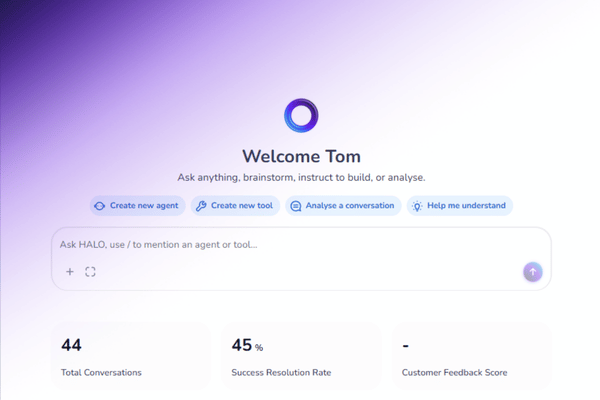
With Ask HALO, business users can build and improve agents by describing what they want to achieve in everyday language. Your service team defines the tasks, keeps knowledge up to date, and reviews the results. Your IT team helps with system access and integrations where needed.
You retain the room to shape and adapt your own service while placing the underlying platform development with us.
Build or buy: which approach moves your customer service forward?
Building your own fits when proprietary technology offers a concrete advantage and you can organize the development and maintenance. For a clearly defined task, that investment can remain manageable.
Buying fits when your primary goal is to deploy and improve AI agents, using existing capabilities for the technical foundation behind them.
For customer service teams that want to automate their own processes and be able to adapt agents themselves, we often see a platform with custom agents as the more sensible investment. HALO provides that foundation so your team can focus on the service you want to improve.