

That changes the make-or-buy question rather than the technology question. If an agent on Meta's channels is what a business needs, there is now a first-party option to weigh against building one that spans the rest of the stack.

Two things are worth saying up front about where we sit. CM.com is a Meta Premier Partner and delivers WhatsApp, Instagram and Messenger to hundreds of organizations, so we have a direct interest in this product working well. We also build HALO, our own agentic AI platform, which puts us in the same category Meta has just entered. Rather than pretend otherwise, we would rather use both perspectives: we know this product as a partner, and we know agentic AI from the inside because we build it.
What Meta actually ships
Meta Business Agent is an AI agent built into Meta's platform, reaching customers across Instagram, WhatsApp and Messenger. Meta launched it globally on 3 June 2026, after roughly two years of testing in markets such as India and Mexico. There are two build routes: self-serve through the WhatsApp Business app, aimed at small businesses, and the Meta Business Agent Platform, which sits on top of the WhatsApp Business Platform account structure larger organizations already have.
An agent learns from past chats, the website and knowledge added manually. Configuration covers five areas:
Knowledge: business information, FAQs, files, website content.
Skills: tone of voice, plus in-chat UI components.
Connectors: calls to a business's own APIs mid-conversation, for live inventory, order status or customer records.
Agent settings: status, handoff policy, and an allowlist restricting who receives AI responses.
Agent events: backend pushes such as shipping updates, for the agent to relay.
Language handling is automatic, and Agent Test and Agent Evaluation allow testing before going live.
Two things to plan around:
Handoff is Meta's call. Human takeover is triggered by Meta's own signals, and the trigger logic is not configurable. Teams with hard rules about when a person must take over should map that before launch. Where that handover lands is a separate question. For organizations already running their WhatsApp Business Platform account through CM.com, that handover reaches the team's existing workspace in Agent Inbox, CM.com's customer service software, so a handed-off conversation doesn't need a new tool to be picked up in.
The agent sits inside Meta's ad infrastructure. Meta positions it as a closed loop: ads drive people into a chat, and the chat feeds back into ad targeting. That framing is Meta's own, and it means customer conversations become an input to advertising.
Where it fits, and where it runs out
Meta points to early deployments in retail and ecommerce, auto rental, food delivery, automotive, payments and travel. The patterns repeat: an agent that suggests complementary products after an order, one that runs a booking end to end inside the chat, one that turns a vague question into a completed order. That is Meta's account of its own early adopters rather than something we have verified.
Those examples share a shape: a self-contained task, one channel, data the agent can reach. That is where Meta Business Agent is strongest, and it is also the ceiling. A conversation that starts in WhatsApp and continues by email or voice starts again from nothing, because the agent's context comes from Meta's platform and the APIs a business exposes to it, not from a customer record the other channels share.
Which makes the fit test reasonably clean:
WhatsApp is a main channel, already carrying real volume. Worth a close look, and no integration work is needed to start.
Contact runs across voice, email, RCS and web as well. The question is not whether Meta's agent works, but which layer should own the agent at all. That is an architecture decision rather than a channel one.
Pricing moves from per message to per token
Standard WhatsApp messaging is priced per message or template. Meta Business Agent adds a category priced per token, at $2.00 USD per 1 million tokens, effective 1 August 2026. A typical automated response uses 20,000 to 25,000 tokens, so roughly 4 to 5 cents per message, or $40 to $50 per 1,000 messages depending on complexity. From 1 October 2026, Meta also starts charging for Service and Utility response messages, which makes all responses to WhatsApp users chargeable from that date.
The billing mechanics matter more than the rate. Meta bills directly through a dedicated credit line in WhatsApp Manager, per phone number, and an existing Business Solution Provider credit line cannot be reused for it. Organizations running the rest of their WhatsApp setup through CM.com will get a second bill from Meta, outside their CM.com invoice, with a cost per conversation that varies rather than a fixed cost per message. That is a forecasting change as much as a pricing one.
Two agentic platforms, two different scopes
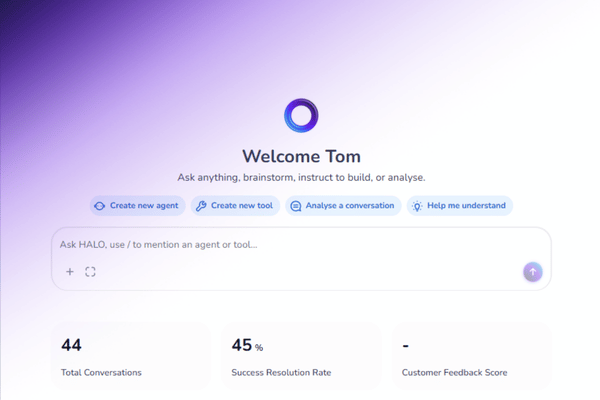
Meta Business Agent and HALO sit in the same technology shift and answer different questions. Meta Business Agent is an agent native to Meta's own surfaces, configured within Meta's guardrails and billed by Meta. HALO is a channel-agnostic agentic platform that runs one agent across RCS, WhatsApp, SMS, email, voice and more, reading and writing to CRMs, payment flows and back-office systems through CM.com's Customer Context Platform.
They are not mutually exclusive. A business can run Meta Business Agent on its Meta channels while HALO handles the rest of the channel mix from the same customer context. The table below is about scope and architecture, not about which is better.
Meta Business Agent Platform | HALO by CM.com | |
|---|---|---|
Channels | WhatsApp, Instagram and Messenger, native to each | RCS, WhatsApp, SMS, email, voice and more, one agent across the mix |
Time to first agent | No API or backend integration required to launch | Integration-led, agents read and write to connected systems from day one |
Context source | Meta's own platform signals, plus whatever APIs the business exposes | Customer Context Platform, connected entities and households across all channels |
Advertising loop | Ads to chat and back into ad targeting, per Meta's own positioning | None; orchestration sits across channels rather than inside an ad platform |
Handoff control | Handoff triggered by Meta's signals, policy configurable, trigger logic is not | Handoff rules defined and adjustable by the business |
Pricing and billing | Per token, billed directly by Meta via a dedicated credit line | Part of CM.com's platform subscription and usage model, one invoice with messaging, marketing and payments |
Governance | Meta's internal standards | ISO 27001 and ISO 42001 certified |
Delivery | Solution Provider required for API-based accounts; billed by Meta regardless | Delivered, supported and billed by CM.com as one vendor |
Finding out whether it fits
The honest answer to whether Meta Business Agent is right for a business depends on the channel mix, the existing WhatsApp setup and what the agent is expected to resolve. Set up a call with CM.com and we will work through those three, including timeline and expected cost. Where it fits, we onboard the business as Solution Provider and help configure the first agent. Where the use case reaches beyond Meta's channels, we will say so.