

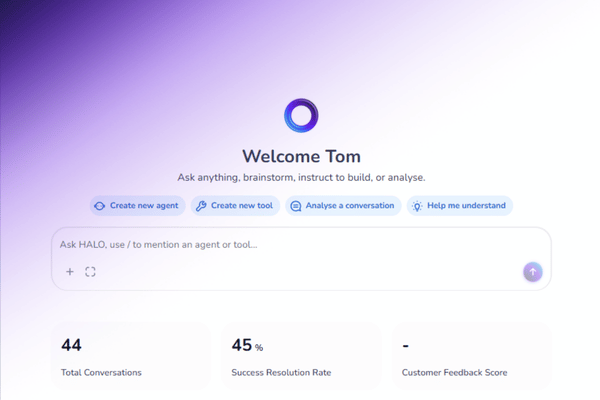
Not just advice, but direct action in HALO
You can paste an agent's prompt into any AI chat tool and get useful advice back. What you cannot do is ask it what your returns agent said to a customer last Tuesday, why it said that, which of your instructions caused it, and then have it fix the cause and test the fix.
That is the difference we built. Ask HALO, now live in HALO Studio, is not an assistant bolted onto the outside of the product. It runs inside your environment, with access to your agents, your tools, your knowledge, your context and your conversation history. Ryan Dingjan at Preston Palace put it plainly after his first week:
Ask HALO has far more knowledge of your platform. It can read everything and change it directly.
Preston Palace
Which means one thing in practice. Everything you would do in HALO, from launching your first agent to keeping twenty of them accurate, you can now do by describing it. Ask HALO can:
• create and adjust agents and tools
• manage context variables and knowledge sources
• add or edit lexicon entries
• look into existing configurations
• analyze conversations
• test changes
Building an agent by describing the problem
If you have no agents yet, the hard part was never the interface. It was knowing what to put in it. What this agent should be allowed to do, which tools it needs, what it needs to know about your business, and how you find out whether any of it holds up.
Describe an agent that answers delivery questions, pulls live order information, and hands off the conversation when a package arrives damaged, and Ask HALO builds it: the agent, the tools it needs, the context variables, the knowledge sources and the lexicon entries. It goes looking for context about your organization instead of waiting for you to fill in a blank canvas. After every change it runs your test cases, so you see what the change did before a customer does.
It also builds the parts that used to need a developer. Jasper van Bree at CheapCargo has Ask HALO write Python inside his tools to make them more robust, which is not work his team would have queued up for a sprint otherwise. His summary of what that does to the day:
Where we use HALO to work more efficiently for our customers, we can now use Ask HALO to use HALO itself more efficiently.
CheapCargo
Seeing your whole HALO setup, not just one agent
An assistant that only knows the agent you have open is of limited use, because almost nothing in a real setup stands alone. Ask HALO can look across your agents, your environments and your past conversations, and make the same change consistently in all of them.
That is what Winparts used it for. They moved their agents onto a new template, which is the kind of job that normally means opening each agent, re-reading it, rewriting it, and hoping you applied the same standard to the last one as to the first.
We used Ask HALO to rewrite our agents to a new template, It mainly helped us to do this faster and in a more structured way, so we did not have to start from scratch every time. Good to be able to move quickly like this without giving up quality.
Winparts
CheapCargo did the same in the other direction. Rather than rewrite agents to match a template, Jasper rewrote the descriptions of all his agents into the phrasing style that performs best, across the whole setup at once. Both are tasks that were always possible in HALO. Neither was realistic to do in an afternoon.
Finding out why a conversation went wrong, and fixing it on the spot
Every team running AI agents eventually looks at the same list: the conversations the agent did not recognize, or handled badly. Reading them is not the hard part. Working out which instruction, which knowledge source or which tool caused it is.
Ask HALO reads that conversation back with you. What the agent did, why it responded the way it did, what needs to change. Then it makes the change and runs the tests.
Ryan Dingjan does exactly this every day at Preston Palace. “I use it daily to analyze chats it did not recognize or did not handle well. It explains how the process works and why something goes wrong, and that is very valuable. And it solves it well too.”
In his first sessions he worked through a backlog of cases this way, including date recognition and handling messages typed with unexpected capitalization, both of which now behave.
Jasper runs the same loop at CheapCargo: analyze unsuccessful conversations, adjust the prompts directly, and raise the share of questions answered correctly next week. That is the whole point of the exercise. Not tidier prompts, but more customers helped without a human stepping in.
Picking up where you left off
Improvement work does not finish in one sitting. Ask HALO keeps your conversations for up to 14 days, so you can reopen one, see the changes you already made, and continue without describing your setup again. Ryan uses that on purpose: he stops making changes before the weekend and picks the thread back up on Monday, rather than starting over.
Conversations stay private, can only be resumed by you, and stay separated per profile. You decide how long that data lives, under Settings in HALO Studio, and once your retention period passes it is permanently deleted.
Working from HALO Studio or your own tools
Ask HALO runs on our new HALO MCP server, which we have made available to everyone. If your team would rather work from Claude, Copilot or Cursor, you can maintain the same environment from there. Studio is the visual way in. The MCP is the same setup for people who prefer their own tooling.
Efficient work, made efficient
Ask Jasper to describe Ask HALO and you get four words: efficient working, made efficient. Ask Henrico de Bruin at Intergamma and you get three: my new best friend.
Both are pointing at the same thing: an agent that does not just answer questions about your setup, but builds, fixes and maintains it directly.
So the question worth asking any vendor is not how quickly you can launch. It is who does the work after that, and whether the thing doing it can actually see what you built.