
But there's a gap between software that gets built and software that actually holds up - and live events expose that gap faster than almost anything else.
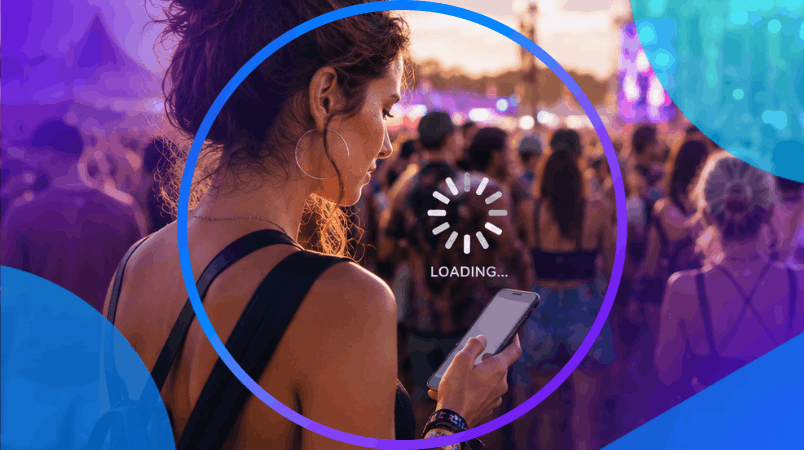
Because once festival weekend begins, your app stops being a product. It becomes infrastructure. It's how tens of thousands of visitors navigate your event, receive critical updates and trust that what they're seeing is accurate and current.
AI can generate the app. It can't generate what happens when that infrastructure is tested at scale and it will be tested.
Here are six things no prompt will tell you.
1. Design for peak moments, not average usage
Festival traffic doesn't behave like most mobile apps. Downloads peak in the days leading up to the event, while usage explodes around gate opening, timetable updates, artist changes and headline performances.
The real test isn't whether your app performs well during development. It's whether it continues to perform when tens of thousands of visitors reach for their phones at exactly the same moment.
Designing for average usage is relatively straightforward. Designing for festival weekend is something entirely different.
2. Communication is operational infrastructure, not a feature
For many visitors, the event app becomes the fastest and most trusted source of information throughout the weekend. When something changes, they don't search your website or scroll through social media. They open the app.
That makes push notifications something entirely different from a marketing tool. They're the mechanism by which you communicate timetable changes, weather alerts and, when it matters most, emergency information.
In seventeen years of supporting live events, we've seen moments where real-time communication became mission-critical. Dangerous weather conditions, overcrowded stages, unexpected safety incidents. In those moments, the app either works or it doesn't. There's no restart button when the crowd is already inside.
The strongest event organisations understand this distinction before the festival starts. The ones that don't usually find out the hard way.
3. A prototype proves the idea. Production proves visitors can depend on It.
One of the biggest misconceptions about AI-generated software is that a polished prototype means the hard work is done.
In reality, that's usually where it begins.
App Store approvals, accessibility requirements, SDK compliance, release management, testing and last-minute updates all need to come together before opening day. Unlike most software projects, there's no option to delay deployment when thousands of visitors are already travelling to your event.
AI lowers the cost of building software. It does not lower the cost of failure. If anything, the easier software becomes to generate, the more valuable operational experience becomes.
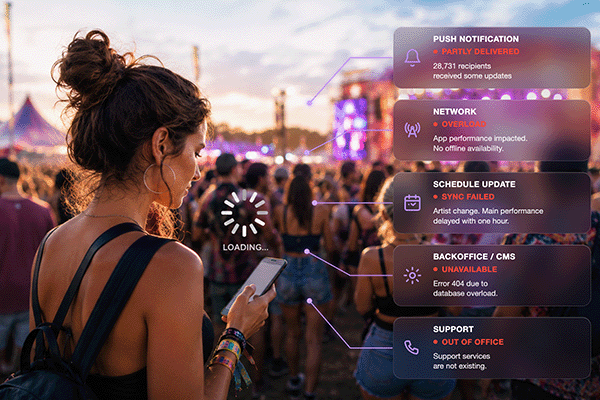
4. Reliability is the foundation of trust.
Visitors share personal data, preferences and behavioural information because they expect something valuable in return. That's an implicit contract - and it's fragile. Privacy, consent management and compliance aren't legal boxes to tick. They're the foundation visitors stand on when they decide whether to trust your event.
The same applies to resilience. Networks overload. Artists cancel. Weather turns. Operational priorities shift within minutes. A secure event platform isn't just one that protects data, it's one that keeps functioning when every system is under pressure at the same time.
The best event teams build for both from day one. Because the question was never if something goes wrong.
It's always when - and whether your platform is ready.
5. The interface is what visitors see. The integrations are what they feel.
Modern event apps rarely operate on their own. They're connected to ticketing, CRM, customer support, marketing automation, payment systems and sponsorship platforms.
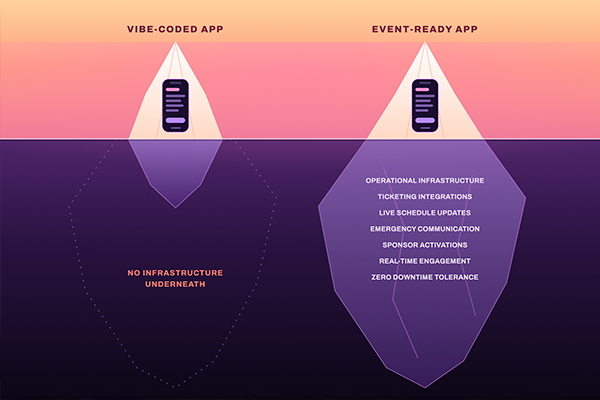
Visitors only see the interface. But the real experience comes from everything happening underneath - offline-capable experiences during overloaded networks, real-time timetable control during unexpected artist changes, scalable push orchestration during crowd moments, sponsor activation systems that keep functioning under live traffic spikes.
Those capabilities don't show up in screenshots. But they absolutely show up during festival weekend.
The stronger those connections, the more valuable the app becomes - not only during the event, but throughout the entire customer journey. The app isn't the centre of the ecosystem. It's the layer that brings every other system together.
6. Great event apps are operated, not just built
Building an app is one part of the job. Running it is another.
Festival weekends are dynamic environments where artists cancel, crowds move unexpectedly and new situations emerge throughout the day. The strongest event apps are supported by monitoring, operational processes and teams that can respond quickly when plans change.
Nobody compliments an app that simply works. Everybody remembers the one that doesn't. Technology enables the experience. Operations keep it running.
A festival app is no longer just an app
The most successful event organisations increasingly see their app as the digital layer connecting ticketing, customer engagement, marketing automation, sponsorship activation and audience data into one connected ecosystem.
Every interaction creates value. A saved performance, a clicked notification, a redeemed sponsor offer - each contributes to a richer understanding of visitor behaviour. Those insights make every future edition smarter, every campaign more relevant and every visitor relationship stronger.
The app doesn't stop working when the festival ends. That's where some of its most valuable work actually begins.
Anyone can build. few can deliver.
AI has fundamentally changed how software gets built. It hasn't changed what makes software successful.
Festival apps aren't judged by how quickly they were developed or which model generated the code. They're judged when thousands of visitors open the app at the same moment. When severe weather forces programme changes. When an artist cancels and your organisation needs to reach everyone in seconds.
Those are the moments that determine whether your app becomes part of a great visitor experience, or part of the problem.
One survives the demo. The other survives festival weekend.