
TL;DR
A customer data platform (CDP) joins customer data from every channel and system into one profile per person and shares it with your other tools.
A CDP differs from a CRM, a DMP and a data warehouse: it covers online and offline data, known and anonymous people, and marketers can run it without code.
A CDP helps with five problems: no single customer view, lost customers, unreliable data, weak personalization and profiles without context.
CM.com's Customer Context Platform (CXP) does what a CDP does, but stores data as linked objects, such as people, companies, products and stores, and predicts what each customer does next.
A customer data platform (CDP) is packaged software that collects customer data from your channels and systems, matches it to one person and shares that profile with your other tools. Marketers can run it without writing code. CM.com’s Customer Context Platform (CXP) does what a CDP does and also stores the things around each customer, such as the company they work for, as linked objects, and predicts what each customer does next.
This guide covers what a CDP is, what data it holds, the problems it solves, how it compares with a CRM and a DMP, the types of CDP, use cases and a checklist for choosing one.
1. What is a Customer Data Platform?
A CDP or Customer Data Platform is a software that collects customer touchpoints and interactions with your product or service from various channels and sources. It aggregates all this data from multiple sources to create a unified profile of each customer.
A Customer Data Platform is packaged software that creates a persistent, unified customer database that is accessible to other systems. - CDP institute
In essence, a CDP has three fundamental properties:
Packaged software: A CDP is a prebuilt system, configured to meet the needs of each client. Some technical resources will be required to set up and maintain the CDP, but it does not require the level of technical skill of a typical data warehouse project. This reduces the time, cost, and risk and gives business users more control over the system, even though they may still need some technical assistance.
Persistent, unified customer database: It collects customer data from multiple sources: creating a unified, complete view of each customer. CDPs pool and track customer data, such as behavioral data and demographics, and use this data to create a 360-degree view of each customer. Identity resolution is the step that matches data from the same person across devices and channels, for example an email address and a website cookie ID, and merges it into one profile.
Accessible to other systems: It has the ability to share this data with other platforms. This is a particular asset when it comes to enhancing customer management and creating highly targeted, personalized marketing campaigns.
2. What can you do with unified customer data?
Act on untapped insights into customers
Despite collecting extensive customer data, most companies are not equipped to create a unified, comprehensive view of each customer. Nor can they easily share this data across different systems. For most companies, customer data sits untapped across multiple systems. This means that most marketing teams only have a fraction of the insight they could have into their customer base — impacting their ability to granularly target and personalize their marketing initiatives.
Meet expectations on every channel
Customers expect an easy experience on every channel, and that starts with knowing who they are and what they did last. A CDP keeps every past interaction on one profile, so you can see where each customer is in their journey and choose the next step. Recommendations become more relevant and service gets faster.
Companies often misjudge how customers feel. In PwC's 2025 Customer Experience Survey, about nine in ten executives said customer loyalty had grown in recent years, while four in ten consumers said the same.
Also read: Why Unify Customer Data? >
3. Why can marketers run a CDP without SQL?
Alternative solutions like data warehouses and data lakes are able to ingest data from multiple sources too. However, there is one important difference with a CDP: setting up and using these types of systems requires more advanced technical skills such as knowledge of SQL and other programming languages. This impacts their usability for most marketers.
Unlike traditional architecture, CDPs are designed to collect, organize, and share data easily across different systems. CDPs generally have a user-friendly interface that does not involve any programming code. As such, CDPs enable marketers to take control of data unification and analysis. CDPs enable marketers to efficiently use customer data to lead targeted, omnichannel marketing campaigns that excel.
In the CXP, a marketer builds a segment with filters. The demo below finds people who work at a company with more than 50 employees: choose the relationship to a company, filter on company size, save the segment, then use it in emails or send it to ad platforms. No SQL skills involved.
4. What data does a CDP store?
Unlike most database software, CDPs are designed to seamlessly manage large volumes of ever-changing customer data. This data may include:
Basic customer data such as a customer's name, age and contact details.
Behavioral data such as a user's journey across a website or in a mobile app.
Buying behavior including products a customer bought or returned.
Customer service data such as chatbot, email or phone-call transcripts, or information in your CRM.
Campaign data such as click-through rates and engagement.
Consent and preferences such as which marketing a customer agreed to receive.
Context data such as the household a customer belongs to, the company they work for and the products they own, stored as objects with links between them. Not all CDPs have this possibility, but our CXP does.
5. Five problems a CDP helps you solve
Problem 1: No single customer view
Without CDPs, customer data exists in separate systems and databases. For example, a telephone number may be in a CRM system, but the online purchases are only in the e-commerce platform. These systems are popularly known as “information silos” or “data silos” because they don’t communicate with each other to resolve duplicate and conflicting datapoints. Using them will result in customers receiving mixed messages. The opposite of a cohesive customer experience. Whether it is service or sales, customers expect you to recognize them in every interaction. This lack of single customer view can have devastating impacts on a company’s bottom line. In PwC's 2025 Customer Experience Survey, 52% of consumers said they stopped using or buying from a brand after a bad experience with its products or services, and 29% stopped because of poor customer experience online or in person. Data stored in separate systems makes those experiences hard to spot and fix.
CDPs were designed to remedy the lack of a single customer view by integrating data from a range of sources and using it to create a single comprehensive view of each customer. In the CXP, every profile has a timeline of website visits, transactions and email opens and clicks, plus identifiers such as an email address and a web tracking ID. When the same cookie ID appears on a phone and a desktop, the profiles merge.
Problem 2: Loss of valuable customers
By loss of customers, we mean customers who don’t come back or cancel. This is also known as the churn rate. The churn rate is especially important for companies that have many returning customers and, for example, sell subscriptions. For these companies, retaining existing customers is more important than acquiring new ones.
Repeat customers are extremely valuable, generating a substantial amount of a company’s revenue. As such, marketing teams are often directed to assign them prime importance. But that’s difficult to do without a single customer point of view. Thanks to their ability to collect and store data on customer buying behaviors, CDPs can identify repeat customers, especially high-value repeat customers that have spent a certain amount with a company.
The data stored by a CDP can also be used for targeted, omnichannel marketing campaigns, designed to engage these customers across every touchpoint.
However, without tracking a customer’s experience across different channels, it’s nearly impossible to track the negative experiences that are pushing a customer towards cutting ties.
To illustrate, an easy way to increase customer satisfaction is by quickly resolving any complaints. However, complaints can be made in a variety of ways, such as in the form of a bad review or an in-store return.
Unfortunately, when these complaints are collected in different systems, they are hardly noticed. CDPs address this issue by ensuring a single customer view that tracks customer interactions and triggers alarms following any negative customer experience. This helps tackle high churn.
Moreover, CDPs can also be used to track and measure another common sign that a customer will churn over the next few months: lack of activity. By measuring a lack of activity, or a customer’s ‘silent complaints’, CDPs can be a powerful tool in helping you to predict and prevent churn.
Beyond tracking and notifying, the real value of a CDP lies in its ability to automate the delivery of support messages to any dissatisfied customer, as well as its capacity to automatically notify one of your customer service agents to reach out to the customer in question.
In the CXP, CXP Predictions goes one step further. It scores churn risk on each profile, so your team can act before a customer leaves.
Problem 3: Unreliable and untrustworthy data
Both first and third-party data are commonly used to drive marketing campaigns. However, first-party data is more valuable, dependable, and less risky than third-party data. Customer data platforms are primarily engineered to focus on owned and trusted first-party data.
As data collected directly from your customers, first-party data is the least risky because you are aware of its source and own it outright. It allows for targeted, personalized marketing initiatives that typically offer far better results.
In comparison, third-party data is collected from multiple sources and often comes from unknown, unverifiable sources. While you can ensure that you store and manage your data in compliance with regulations like GDPR, it is far harder to verify whether third-party vendors are doing the same.
Third-party cookies also remain an unstable base. In April 2025 Google said Chrome would keep its current approach to third-party cookies and not add a separate prompt, and in October 2025 it announced it is retiring most Privacy Sandbox technologies. Safari blocks third-party cookies by default, and Firefox blocks cross-site tracking cookies by default. Data you collect yourself does not depend on those decisions.
Moreover, third-party data in the form of audiences and campaign data utilized on platforms such as Facebook and Google, is never owned outright by the account user. If the platform you are using decides to suspend its service or suspend your account, you lose the data.
In addition, third-party data may also have been poorly aggregated and can be difficult to integrate with existing data. In contrast, when it comes to integrating third-party datasets when needed, CDPs emphasize quality control and integration at scale.
CM.com's CXP collects first-party data through its own web tracker, which stores website visits next to purchases and email interactions in the same profile.
Problem 4: Lack of personalization
Personalization is a big marketing buzzword, but it can be next to impossible to achieve without a strong omnichannel strategy that delivers a personalized experience to customers as they move between touchpoints, from app to desktop, from laptop to store. A lack of personalization can make customers feel unvalued. The single customer view delivered by CDPs ensures that every interaction with a brand can be tailored to each customer.
The Formula 1 Heineken Dutch Grand Prix shows how this works. For six editions, from 2021 to the final race in 2026, CM.com ran its ticketing, chatbot, app and marketing data as one system, not as separate tools. Every fan interaction feeds the same fan profile: what a fan searches for, what they look at in the app and what they ask during the race. Teun Verheij, then head of marketing at the Dutch Grand Prix, told Adformatie that building a strong database from the start made one-to-one communication with fans possible.
That profile drives the communication. In the final edition, campaigns went out on RCS to 30% of recipients and on WhatsApp to the rest. RCS got 58% higher engagement than WhatsApp. Fans whose phones could not receive RCS fell back to WhatsApp automatically, so nobody was skipped. In the app, segmented news cards showed each fan the story that mattered to them, instead of one generic feed. This is what the Dutch Grand Prix built, not a promise of what you will get.
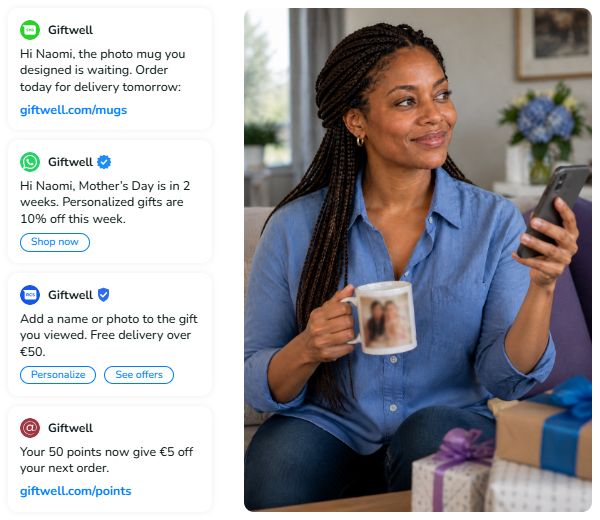
Segments tell you who to talk to. Predictions tell you what to say next. CXP Predictions forecasts what each customer does next and writes the forecast to the profile, so campaigns and agents can pick the next best action.
Problem 5: A flat profile has no context
A profile tells you who a customer is. It does not tell you how that customer connects to the rest of your business. A CDP stores everything as a property of a person. But most of what you need to say something useful to a customer is not about the customer. Think of an airline: a cancelled flight is about the flight, not about the 300 people who were going to sit in it. Stock belongs to a product, opening hours to a store, a policy to an insurance product.
In a model where every data point must hang on a person, that data has two options. It goes into another system, or it gets forced in where it fits. We see companies store their shops as customer records in their CRM, because they want that data in the same platform and the platform was not built for it.
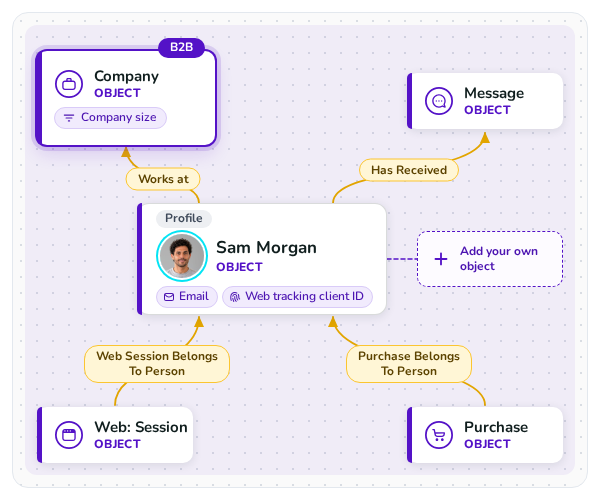
CM.com’s CXP stores these things as objects of their own, with relationships between them. A customer has a ticket, the ticket is for a flight, and the flight runs with an aircraft. Now a question such as “who is affected by this cancelled flight?” is a single query, not an export, a merge and a sprint.
There is a second reader of your customer data now: AI agents. A person wants an interface with buttons. An agent wants an API. That difference is small. What is not small is that an agent has to follow relationships that nobody defined in advance. Take a question that sounds easy: what are the opening hours of the nearest store? The agent needs to know who the customer is, where they live, how far the stores are and what the opening hours are today, and those change with holidays and staffing. If that data sits in separate systems, the agent either asks the customer where they live and still lacks the answer, or it has to go through the records of every system. If it sits in one connected model, it is a single question.
You decide which objects your business need. In the data manager you define them yourself, or you start from a template that installs them for you. When your business changes, you add a new object with a few clicks and connect it to the rest.
6. CDP vs DMP vs CRM
By now you might be wondering “what if I already have a CRM or DMP?”. The short version is that a Customer Data Platform (CDP) does not replace either, but acts complementary. The best way to explain the differences is to take a look at the history of these solutions and the problems they intended to solve.
Online Customer Relationship Management (CRM) software entered the market in 1997 and was designed to enable companies to easily manage their relationship with leads and customers. CRMs collect first-party data on known prospects and customers — enabling businesses to nurture leads, manage and retain customers more effectively, and support collaboration within sales teams. Vulnerable to human error, the data inside a CRM is only as good as the input and maintenance of the sales reps and account managers who use it.
Utilized by professionals in advertising, focused on building awareness — with visibility and impressions as their driving KPIs, Data Management Platforms (DMPs) hit the market in the 2000s. In the early 2000s, DMPs were exclusively used by digital advertising buyers and publishers — looking to store and manage audience data from a range of sources and use this data to create advertising segments. DMPs process and organize second and third-party data, they are predominantly cookie-based and use anonymous IDs for profiles.
The next in line, Customer Data Platforms arrived to directly combat the data silos created by DMPs and CRMs. CDPs combine a company’s first party, second party, and third-party data — including data from point-of-sale systems, IoT devices, loyalty applications, CRMs, and DMPs. CDPs then combine this data to create unique customer profiles that provide an in-depth, 360˚look at each customer. CDPs are typically utilized to deliver personalized customer experiences and targeted, omnichannel marketing campaigns.
CDP vs CRM
Despite the fact that both CDPs and CRMs collect and store customer data, they have several distinct differences:
CDPs collect data on anonymous visitors, while CRMs only provide data on known customers or potential customers.
CDPs can be used to track online and offline customer data. CRMs can track offline data if it is entered manually or via an integration, but this ability is never native to a CRM in the way it is with a CDP.
CDPs can be used to analyze lifetime customer behavior and customer journeys, whereas CRMs predominantly analyze the sales pipeline.
CDPs are designed to manage and integrate a large volume of data from multiple sources — ensuring it is securely integrated and stored. In contrast, CRMs collect individually entered data that’s vulnerable to loss and misidentification.
A CRM stores the accounts and contacts your team enters. The CXP builds objects from the events that arrive from your channels, such as web visits, orders and email clicks, and links them to each other. A person can connect to a company, a household, products they own or a store, and you can segment on any of those objects and their relationships.
CDP vs DMP
David Raab, founder of the CDP Institute, succinctly covers the difference between CDPs and Data Management Platforms (DMPs), he states: “CDPs work with both anonymous and known individuals, storing ‘personally identifiable information’ such as names, postal addresses, email addresses, and phone numbers, while DMPs work with almost exclusively with anonymous entities such as cookies, devices, and IP addresses.”
CDPs can be used in all kinds of marketing, whereas DMPs are typically used in advertising in order to target ads more effectively and reach new audiences.
CDPs predominantly collect high-quality, first-party data, while DMPs mostly collect thirdparty data — such as the data acquired through data providers, managers, and services.
CDPs collect personalized customer identifiers — such as a customer’s name and contact details. In comparison, DMPs only store anonymous customer identifiers, such as cookies.
CDPs are designed to create thorough, accurate customer profiles. As such, they retain data over a long period of time. In comparison, because DMPs are designed to target ads and reach new audiences, they only retain data for a short period of time. This is down to the fact that when you purchase data like an audience list you enter into an agreement to only use this data for a specified time period.
CDP vs data warehouse
A data warehouse stores data that a technical team models and queries, usually with SQL. A CDP is packaged software that marketers configure, with identity resolution and activation built in. Some vendors now build CDPs on top of a warehouse. Both approaches exist, and the packaged type is quicker to start with.
Read more in our blog: CRM, CDP and DMP Platforms: How Are They Different?
7. Which types of CDP exist?
It helps to know the types so you can pick the one that fits. Below, we compare two: standalone and customer engagement.
Standalone CDP
A standalone CDP has one job: to integrate a company’s first-party customer data and turn this data into a comprehensive, 360-degree view of each customer. You can use a standalone CDP to create segments and share customer data with your other systems, but you’ll need other software to fully execute marketing and customer engagement campaigns. The most obvious one being email campaign software, but don’t forget landing page builders or mobile messaging channels.
Often times there are ready to use integrations present for the most popular marketing solutions. But in case these are not available for software you are already using, all CDPs offer APIs to make your own integrations. A standalone CDP makes sense for companies that already have marketing campaign software, have development capacity available and are just looking for ways to unify their customer data.
Customer engagement CDP
Great as an all-round solution that can also be easily integrated into your tech stack, a customer engagement CDP is the same as a standalone CDP but with extra marketing capabilities built in.
CM.com's Customer Context Platform (CXP) is built this way. It is the foundation of the CM.com platform: campaigns, messaging, service and HALO AI agents run on top of it and work from the same customer record. The CXP also goes a step further than most engagement CDPs, which the next section explains.

8. What does a CXP add to a CDP?
A CDP stores everything as a property of one entity: the person. A Customer Context Platform (CXP) keeps that profile and also stores what is not about a person as objects of their own, such as companies, households, products, stores and orders, with the relationships between them.
CM.com's CXP adds four things to a standard CDP:
Connected context, not only profiles. The CXP stores objects such as a person, a company, a household, a store or a product, and the relationships between them. A graph view shows how the objects connect.
Predictions on the same record. CXP Predictions trains a separate model for each customer, trained on that customer’s own data. It predicts what to send to whom, at which moment, and how likely a customer is to churn, and it writes the result to the profile. That supports the next best action: the one step that fits this customer right now, for example an offer, a reminder or no message at all. In CM.com’s own tests with customers, recommendations had twice the hit rate of the previous setup. Part of that comes from the new model and part from the connected data.
Segments and triggers that stay current. Segments update on their own as new data arrives, and they can use any object and relationship in the model. A trigger starts a HALO automation, such as an email, an SMS or a journey, when a customer joins or leaves a segment or when a tracked event comes in.
One foundation for the CM.com platform. The CXP sits under CM.com's campaigns, messaging, service and AI agents. Marketers, service teams and HALO agents read the same record, and people and agents reach it through the same API. An email open or click appears on the profile without a separate integration.
A CXP does not replace the basics. Identity resolution, consent management and segmentation work as they do in any CDP. Context sits on top.
How the CXP compares with a typical CDP:
Typical CDP | CXP (CM.com) | |
|---|---|---|
Unified customer profile | Yes | Yes |
Identity resolution across devices and channels | Yes | Yes |
Data model | Usually person profiles with their events | Objects and relations: person, company, household, product, store, and the links between them |
Segments | Built on profile data and behavior | Built on the person and everything linked to them, and updated automatically |
Activation | Usually sends data to other tools; some CDPs also send campaigns | Campaigns and messaging run on the same platform, plus open APIs and connectors to your other tools |
Predictions | Often a separate tool or add-on | CXP Predictions score churn, value, intent and next purchase on each profile |
Service and AI agents | Usually outside the CDP | HALO agents and service teams read the same record |
Fits best when | you need one unified profile for marketing | your customer data serves marketing, service, sales, and both human teams and AI |
What does context look like in practice?
Context matters differently in each industry. Three examples show the idea. They illustrate what the data model allows and are not customer results.
B2B: segments built on the company. A software company links people to the company they work for. A marketer builds segments on the company's properties and on how people relate to it. Segment on any company property you store, and on how people relate to the company
Travel: the household as one unit. A travel company stores a household as one object, linked to each traveler. An offer for a family trip goes to the household, and not to four separate inboxes.
Retail: the store next to the customer. A retailer links each customer to a store object that holds its location and opening hours. A message can then name the store the customer actually shops at.
9. Use cases of a CDP
1. Connect all offline and online touchpoints
CDPs bring together all of your data, including data from your CRM, DMP, loyalty applications, point of sale systems, and IoT devices to create holistic customer profiles that reflect customers’ entire interactions with your company. This enables you to remember a customer and personalize every interaction with them, whether they are in store, at their desktop, or on mobile.
2. Build smart customer segments and personalize
CDPs enable you to integrate customer data from different channels and transform this data into real-time, actionable customer segments. You can create smart customer segments based on as many rules and filters as you like, make them as granular and complex as you need — or just keep your segments simple. No matter your approach, you have extensive options available to make your communication more relevant and personal to your customers.
In the CXP, a segment can use the person and everything linked to them, such as a company, a household or the products they own. Segments update on their own as new data arrives, and you can use them in emails, in automations or as ad audiences.
3. Recommend products and services
Increase your average order value by powering recommendation models with real-time customer data. Netflix, YouTube, and Amazon algorithms are all great examples of this at play; always recommending people the next best thing to watch or buy. In the CXP, CXP Predictions supplies the next best action per customer.
4. Enhance your online advertising audiences
Most CDPs can be integrated with the big online advertising platforms, from Google to Facebook, and used to retarget your audiences and create lookalike audiences for more impactful advertising. Retargeting based on website activity is common, by tracking pixels from the ad platforms, but retargeting based on offline events and other systems integrated with your site is something a CDP makes possible.
5. Automate omnichannel marketing
Use data on customer behaviors, such as interactions with your site and purchase history, to create customer profiles that power a personalized, omnichannel marketing strategy. By tracking a customer’s journey across every platform, you can automate personalized marketing messages that increase your conversion and customer retention rates. Because CDP’s already have connections with many systems in order to collect data, they can easily track customers across every single channel. Moreover, CDPs can also be the starting point for sending automated messages to customers over each channel. While most marketing automation tools only focus on e-mail, a CDP can potentially do much more. Automating RCS, WhatsApp, SMS, email and voice messages, and more.
6. Analytics - data-informed marketing
CDPs offer rich customer data that can be used to create data-informed hypotheses about what customers want and need based on prior behavior. In addition, real-time customer data can also be used to test, evaluate, and optimize marketing campaigns.
7. Run account-based marketing
Link people to the companies they work for, segment on company properties such as size, and send each segment a message that fits.
10. How to choose a CDP: 7 questions
If you’ve decided a CDP would make a great addition to your martech stack, it’s time to ask the question: How do I choose the right vendor for me? In order to make the best choice, you need to ask these seven questions:
Frame your vendor research with your use cases in mind
Based on the above use cases, reflect on how a CDP can fit into your current business needs. Will you use your CDP to understand and optimize the customer journey across different channels? Do you need a tool that can unify your customer information and combat data silos? Are you looking for a tool to help you create more granular customer segments? Consider whether a Standalone CDP or an enhanced CDP like the CXP would best suit your needs and your budget.Check how much implementation help you need
A CDP needs less technical skill than a data warehouse project, but someone still has to connect your sources and keep the data clean. Ask what the vendor does during onboarding.Consider usability
Does the CDP you’re considering require advanced technical skills? Do you have someone in the team who can use it with ease? To ensure usability, we return to the importance of always requesting a demo before you buy.Ask for a demo
Who can best meet the needs of your team? Make a list of vendors that could fit your requirements. Next, contact the company and discuss their experience with similar use cases and ask them to show you their solution with a demo. Ask the vendor to build a segment live, with your own example.Follow up on referrals
You’ll only know how well a CDP really performs by speaking with a provider’s customers. Ask for referrals and dive deep into their experiences with the brand and solution. We recommend you come prepared with questions on usability, data integration, the quality of customer profiles and segmentations, ROI, and customer support.Check that the data model fits your business
Can you add objects such as companies, households or products and link them to people, or does the CDP store only person records?Check how the CDP acts on the data
Does it send messages itself or do you need other tools? Can you use predictions in segments and journeys?
11. Why consider the CXP?
Many CDPs stop at the profile. CM.com’s Customer Context Platform (CXP) goes further. It unifies data from your channels and systems, models the relationships around each customer, predicts what each customer does next with CXP Predictions, and lets your marketers, service team and AI agents work from the same record.
The CXP is open. You connect the CRM, commerce platform, ERP or warehouse you already use, so you do not have to replace your stack.
Not every company needs it. If your customer relationships are simple and stable, and you already know which fields you will need in five years, a CDP does what it should. If your segments depend on relationships, if your business changes faster than a fixed data model can follow, or if you want AI agents and your team to work from one record, the CXP is the better fit.
FAQs

A CDP is packaged software that collects customer data from your channels and systems, matches it to one person and shares that profile with other tools. Marketers configure it without code. It differs from a data warehouse, which a technical team builds and queries with SQL.
A CDP stores customer data as properties of one entity: the person. A Customer Context Platform (CXP) stores people and everything around them as separate objects, such as companies, households, products, stores and orders, with relationships between them. That lets you ask questions that cross objects, and it lets AI agents follow relationships that nobody defined in advance. A CXP still does what a CDP does: one profile per person, identity resolution, consent and segments.
An AI agent can read data from a CDP through an API, but it works best when the data and the relationships between data points are in one place. A profile built around the person holds only what is about the customer. An agent also needs context such as stores, products and orders, and how they connect to the customer. In CM.com’s CXP, marketers, service teams and AI agents read the same record.